Animals
 Animation
 Art of Playing Cards
 Drugs
Drugs Education
 Environment
 Flying
 History
 Humour
 Immigration
 Info/Tech
 Intellectual/Entertaining
 Lifestyles
 Men
Men Money/Politics/Law
 New Jersey
 Odds and Oddities
 Older & Under
 Photography
 Prisons
 Relationships
 Science
 Social/Cultural
 Terrorism
 Wellington
 Working
 Zero Return Investment
A Waste to Refuse
Waste Not, Want NotMorning. Dark and Cold. Quickly downstairs I race - hurry, hurry. Fling on coat, grab bag, throw open
door. Cats scatter as I tear down the path. - Kay Francis, Thorndon from Brian Edwards' Book of Incredibly Short Stories Tandem Press 1997 by Barry Hawkins
Paper Mountain - Sophie Karehana sorts paper for recycling at New Zealand Paper Recyclers' wharf depot in Wellington Recycle, reuse, rehash, reconstitute... it can all get a bit relentless. Doing your bit to save the world by recycling doesn't always leave a warm inner glow. Sometimes it can make you homicidal. You carefully separate the salvageable items from the rest of the household trash and place them in the green Wellington City Council recycling bin. Along comes the truck to take your neatly parcelled cans, plastics, paper and bottles to the recycler. But what's this then? Your recyclables are lobbed into rubbish headed for the landfill. Outraged, you tell the council what it can do with its recycling system. You vow that from then on everything goes to the dump and others can worry about the planet. Council's solids waste manager Ken Mulholland admits this sometimes happens. "We have seen it ourselves," he says. It is hard to imagine anything more calculated to turn residents off recycling. He says it is a breach of the collection contract. "On occasions there has been some irresponsible activity undertaken by some of the workforce. They have not followed their job instructions. We hate to see it happen." Those involved are "disciplined" but the blow to the credibility of household refuse recycling isn't as easily patched up. Mulholland is aware of public suspicions that this sort of thing is widespread but he says these fears are misplaced. The bulk of the items are recycled. He hopes that as collection contracts are now up for renewal the council will be able to impose tougher conditions aimed at eliminating the problem. "There have been two contractors one collecting rubbish, one recyclables. There has been a bit of conflict on occasions. We've had two trucks wanting to do the same street at the same time getting in each other's way. Perhaps one contractor has interfered with the other's materials," he says. "We want to eliminate that completely. It gives a very bad impression if you have gone to a lot of trouble to wash your containers, put them in the recycling bin and then you happen to see your bin being emptied into a rubbish truck. You are likely to be extremely annoyed." There are other gripes about the system. Many involve the bins, which have no lids. Contents, especially paper, gets blown away and it is not uncommon to see empty bins bowling along in the wind like tumbleweeds. Thieves sometimes beat the official collectors to valuable aluminium cans. A person driving a BMW was spotted removing cans from bins in Lyall Bay. Residents disenchanted with the failings of the domestic collection system who still want to recycle say they are being thwarted by the council's decision to close some recycling stations. Mulholland says though the glitches attract publicity the six-year-old system which costs about $1 million annually is working fairly well. The latest survey shows 40% of the city's householders are putting out their bin weekly, 67% monthly. He says comparisons with other cities can mislead because of the different systems used but hopes changes to the new collection contracts will encourage more to take part. Mulholland describes himself as an ardent recycler. He and his wife put their bin out every two weeks. They put out a refuse bag, which costs $1, every four weeks. Not surprisingly, he has a more acute awareness of the problems of waste disposal than most. "There is a cost in recycling but there are great benefits in educating people about the horrors of waste disposal, waste production." There is also the feel-good factor. "Doing something, even if it seems not a lot, is worthwhile. What did I read in this morning's paper? The rainforests in the Amazon Valley are disappearing at the rate of 20,000 square kilometres a year. In Wellington we get these tremendous winds blowing every day with the El Nino weather pattern. Is this as a result of the loss of the rainforests? "I think to myself I'd better get stuck into my recycling." Every little bit helps. Where Does It All Go?Who does what with Wellington city's refuse for recycling? Paper and cardboard - Most shipped to Manila and made into newsprint and fibreboard. Plastics - Various types sent to plants in New Zealand and Australia for making soft drink bottles, household and industrial containers, pipes and WCC recycling bins. Aluminium cans - Recycled by Comalco at a smelter in New South Wales to make more cans. Steel cans - Melted down at Glenbrook steel mill for various products, including steel reinforcing. Glass bottles - Melted for reuse. Source: The Evening Post Wednesday 4 February 1998; photo credit Phil Reid
Japanese Trash Talk Won't Go to Wasteby Norimitsu Onishi Yohohama, Japan - When this city recently doubled the number of garbage categories to 10, it handed residents a 27-page booklet on how to sort their trash. Highlights included detailed instructions on 518 items. Lipstick goes into burnables; lipstick tubes, "after the contents have been used up," into "small metals" or plastics. Take out your tape measure before tossing a kettle: under 12 inches, it goes into small metals; over that, it goes into bulky refuse. Socks? If only one, it is burnable; a pair goes into used cloth, though only if the socks "are not torn, and the left and right sock match." "It was so hard at first," said Sumie Uchiki, 65, whose ward began wrestling with the 10 categories in October as an early trial. "We were just not used to it. I even needed to wear my reading glasses to sort out things correctly." To Americans struggling with sorting trash into a few categories, Japan may provide a foretaste of daily life to come. In a national drive to reduce waste and increase recycling, neighborhoods, office buildings and towns and are raising the number of trash categories - sometimes to dizzying heights. Indeed, Yokohama, with 3.5 million people, appears slack compared with Kamikatsu, a town of 2,200 in the mountains of Shikoku, the smallest of Japan's 4 main islands. Not content with the 34 trash categories it defined four years ago as part of a major push to reduce waste, Kamikatsu has raised the number to 44. In Japan, the long-term push to sort and recycle aims to reduce the amount of garbage that ends up in incinerators. In land-scarce Japan, up to 80% of garbage is incinerated, while a similar ratio ends up in landfills in the United States. The environmentally friendlier process of sorting and recycling may be more expensive than dumping, experts say, but it is comparable in cost to incineration. "Sorting trash is not necessarily more expensive than incineration," said Hideki Kidohshi, a garbage researcher at the Centre for the Strategy of Emergence at the Japan Research Institute said. "In Japan, sorting and recycling will make further progress." For Yokohama, the goal is to reduce incinerated garbage by 30% over the next 5 years. But Kamikatsu's goal is to eliminate all garbage by 2020. In the past 4 years, Kamikatsu has halved the amount of incinerator-bound garbage and raised its recycled waste to 80%, town officials said. Each household now has a garbage unit that recycles raw garbage into compost. At the single Garbage Station where residents must take their trash, 44 bins collect everything from tofu containers to egg cartons, plastic bottle caps to disposable chopsticks, fluorescent tubes to futons. Masaharu Tokimoto, 76, recently drove his pick-up truck to the station and expertly put brown bottles in their proper bin, clear bottles in theirs. He looked at the labels on cans to determine whether they were aluminium or steel. Flummoxed about one item, he stood paralysed for a minute before mumbling to himself, "This must be inside." Some 15 minutes later, Tokimoto was done. The town had gotten much cleaner with the new garbage policy, he said, though he added: "It's a bother, but I can't throw away the trash in the mountains. It would be a violation." In towns and villages where everybody knows one another, not sorting may be unthinkable. In cities, though, not everybody complies, and perhaps more than any other act, sorting out the trash properly is regarded as proof you are a grown-up, responsible citizen. In Yokohama, after a few neighborhoods started sorting last year, some residents stopped throwing away their trash at home. Garbage bins at parks and convenience stores began filling up mysteriously with unsorted trash. Enter the garbage guardians, the army of hawk-eyed volunteers across Japan who comb offending bags for, say, a telltale gas bill, then nudge the owner onto the right path. One of the most tenacious is Mitsuharu Taniyama, 60, the owner of a small insurance business who drives around his ward every morning and evening, looking for mis-sorted trash. He leaves notices at collection sites: "Mr So-and-so, your practice of sorting out garbage is wrong. Please correct it." Source: indystar.com from The New York Times 13 May 2005
Bucks to Be Made in Zero Wasteby Mathew Dearnaley and Simon Collins
The centre has become a major employer in a district of high joblessness, paying about $36,000 a month to 20 or so staff, and hiring up to 100 people a year for contracts in a range of activities from forestry to running the town's public swimming pool. Recycling supervisor Lillian Cassidy, a former Auckland truck driver who moved back to Kaitaia with her husband, at first thought that sifting though society's cast-offs would be "right at the bottom of the scale." But she has since become an ardent advocate for recycling, taking pride in the service she is supplying to the community and environment. Meanwhile, in Opotiki, the district council's commitment to a "zero waste" society struck a less convivial chord at first, despite promises of a better environment and jobs for the long-term unemployed. "There were 150 people in a hall baying for our blood," recalls district engineer David Reece of the reaction 18 months ago to the withdrawal of council rubbish skips from four coastal communities. But he no longer has to deal with complaints about horse entrails, car bodies and broken furniture being strewn around the bins, and says there is little evidence of illegal dumping. The introduction of tipping fees backed by kerbside recycling in urban Opotiki has left the district with 60% less residual waste, emboldening the council to stop searching for a replacement for its existing landfill, which is due to close in two years. It expects more big cuts from the planned establishment of two new recycling centres, between Opotiki and East Cape, and is negotiating to truck the rest out of the district after running into opposition to an alternative landfill site. Mr Reece admits he was among the doubters when an idealistic young Australian environmental consultant swept into the area, bent on changing his ways. "I thought throwing rubbish in a hole was cheaper than anything else, and took a bit of convincing, but now I wonder why I thought the way I did." Selling recovered resources helps to pay the wages of four previously unemployed people, and there will be two more jobs when the branch recycling centres open. Modest though that might be, they are jobs plucked straight out of the waste stream, and the first chance of steady work for some. Thirteen other jobs have been created in the district by a $1.3 million scheme, financed largely by the Eastern Bay Energy Trust, which has padded out 1000 homes of community card-holders with energy-saving materials. A further 400 homes are awaiting similar treatment. Low-income householders such as pensioners and sickness beneficiaries no longer have to huddle under blankets to keep warm, and are reporting fewer coughs and wheezes. Other communities, including Thames and Waitara, have received subsidies from the Government's Energy Efficiency and Conservation Authority for similar projects, and the Auckland People's Centre is trying to drum up funds to insulate up to 300 Manukau homes. The Kaitaia community business centre not only runs the town's recycling base and an associated kerbside collection, but operates depots in Te Hapua and Russell and is preparing a waste reduction plan for the Far North District Council. It has four tutors touring schools with a "slash trash" message, owns plant and tree nurseries from which it runs landscaping and afforestation services, and holds shares in a solar water-heating firm providing subsidised units to community-card holders. These are all practical examples of a concept dubbed natural capitalism, which is uniting business leaders and environmental activists in a global movement aimed at wiser uses of the earth's dwindling natural resources. The idea is that by valuing resources as natural capital, competitive business advantage can be gained by doing more with less, plugging "leakages" from local and national economies and leaving more money in circulation. In a finite world where there is an over-supply of labour, but the store of once-plentiful natural capital has been drawn down to dangerous levels for short-term profit, the mission is to improve resource productivity rather than continue to shed labour. Paul Hawken and co-authors Amory and Hunter Lovins have written in their bible of the new order, Natural Capitalism, that greater gains can come from "firing" wasted energy capacity, oil and forest pulp - while hiring more people to do so. The trio, have been hugely influential in their native United States, with President Bill Clinton and corporate giants paying close heed. When Mr Hawken addressed a conference in Christchurch in June with fellow sustainability evangelist and Interface carpets company chairman Ray Anderson, Prime Minister Helen Clark rescheduled her weekly cabinet meeting to listen in. She was challenged by Mr Hawken to help New Zealand to take advantage of its small size by becoming the first fully sustainable country, with a suggestion we could as an island nation adopt new technologies based on hydrogen from the waters surrounding us. Mr Anderson, whose company is the world's largest commercial carpet-maker, has pioneered a system of leasing the "services" of his carpets, which can be resold once leases on them expire, while leaving more cash in customers' hands to spend on other services. New Zealand firms ranging from Fletcher Challenge and the Dairy Board to The Warehouse and Hubbard Foods have, meanwhile, set up the Business Council for Sustainable Development, aimed at balanced social, environmental and economic development. Although sceptics might paint it as a pale-green alternative to the Business Roundtable, growing ranks of environmentalists see a strategic alliance with corporates as the only way of redirecting the global materials flow in time to avert ecological disaster. Opotiki and the Far North are not isolated examples of efforts at grassroots levels in New Zealand. They are among 26 communities whose councils have signed to a radical goal of cutting their waste contributions to landfills to zero by 2015. The roll covers 1/3 of the country's local bodies, with each receiving incentive payments of $25,000 from the Zero Waste trust, which is financed heavily by the Tindall Foundation of The Warehouse founder, Stephen Tindall. No northern cities have yet joined the cause, but Christchurch and Dunedin are on the list, as are Thames-Coromandel, Otorohanga, Ruapehu, Kawerau, Gisborne, Wairoa, Palmerston North, Hastings and Porirua.
"Waste is something business can relate to - business understands it very clearly because waste impacts on its bottom line." He says a growing band of designers around the world are working out ways to make products easier to pull apart for recycling, including those at Auckland whiteware and healthcare equipment manufacturer Fisher & Paykel. And he says manufacturers are realising that when products are designed for disassembly, they become simpler and hence cheaper to make, while those who remain inefficient will be driven out of business. At the other end of the "pipe," a survey two years ago found Auckland's recycling industry was already employing more than 1,700 people at an average hourly wage of $12, and turning over at least $132 million annually. One fIrm, Environplas Industries in Papakura, has added waste plastic granules to cement to develop light but tough patented paving slabs which it believes will become internationally competitive because of the lower freight costs. Paralleling the Zero Waste campaign is the 28-member Mayors Taskforce for Jobs, which wants to take a leadership role in battling unemployment after the failure of successive Governments to get it below about 6% of the workforce. The latest Household Labour Force Survey figure of 5.9% is the lowest in 12 years, but the taskforce is challenging the Government to support it in efforts to achieve a "zero waste" of people.
The taskforce is preparing an action plan to ensure that by 2005, everyone under 25 either has a job or is training for a useful role in society.
Mr Colquhoun says community organisations are able to operate below break-even points, and hence employ more workers, if only the Government would provide top-up finance for "social entrepreneurs" such as himself to play their part. He is disappointed his centre has had to trim job-creating operations to survive, while the Government seemingly prefers to spend more than $1 million a week on unemployment and related benefits in Kaitaia, not counting crime and other social costs. He says there is no way capital investment can create enough jobs for the area's 1,600 unemployed. A planned expansion of Juken Nissho's mill would produce 150 jobs at most, leaving community employment as the only tolerable alternative. Source: Weekend Herald 11-12 November 2000; you can contact the authors by emailing mathew_dearnaley@herald.co.nz or simon_collins@herald.co.nz See also:
Not Everyone, However, Agrees on Recycling's Value...Recycling: Reducing Waste or Waste of Time?by Martin Earnshaw From hand-me-down clothes to the reuse of scrap metal, people have recycled throughout history. However, it was usually poverty that forced people to "make do and mend". It is a sign of our affluence that we can now buy and throw things away without worry. We can afford to replace our clothes rather than mend them and ensure that we have good quality food at all times (a by-product of which is we can throw away some of it). This gives us the time to do other things. It is therefore something of an anomaly that we are today increasingly asked to think about the implications of our waste. "Reduce, Reuse, Recycle" has become an almost unquestioned mantra of our time. It is claimed that recycling will save the planet. Less energy and fewer resources would be used in manufacture and disposal, and recycled or composted food waste would reduce methane emissions from landfills. More pressing from the government’s point of view is the need to meet EU landfill reduction targets. If these are not met by 2013, the UK stands to pay £200 million in fines (House of Commons 2007: 6). Finally, it is claimed that recycling saves money, therefore increasing economic competitiveness. Changing behaviourIt can be questioned, however, whether municipal (household) recycling is worth it. Recycling has become a prime political issue. As is typical of politics these days, the trend is to exhort us to change our behaviour. Behaviour change is necessary, because as the Department for Environment, Food and Rural Affairs 2007 Waste Strategy tells us, "If everyone consumed as many natural resources as we do in England, then ... we would need 3 planets to support us" (Defra 2007: 9). The waste strategy is essentially a call for ordinary people to "share responsibility" for their consumerism. Recycle Now and similar campaigns offer helpful hints to help us reduce our waste. If the requested behaviour changes are not forthcoming, however, then the carrot and stick are employed. Despite talk of incentives, there are economic reasons why the stick is more likely to be employed than the carrot. As the House of Commons Committee on Refuse Collection notes: "The downside of an incentive scheme is that someone would have to pay for it" (House of Commons 2007: 32). In other words, people would have to be fined regardless of whether everybody recycles or not. Some methods of encouraging people to recycle, such as fortnightly or "alternate weekly" rubbish collections, are cheap. However, this has the downside of lumbering householders with biodegradable rubbish for 2 weeks. The Commons committee says that there’s no evidence that this poses a health risk, though it acknowledges that it might be difficult to persuade the general public of this given the strength of anecdotal evidence about flies and maggots (15). Financial penalties tend to encourage fly-tipping, dumping of rubbish in neighbours’ bins, and transfer of unsuitable waste to the recycle bin. The proposed solutions - "bin police", electronic bin chipping, and most recently the proposal that councils provide lockable bins to prevent disputes over the ownership of rubbish (35) - promote an atmosphere of surveillance that sits ill with the idea that a culture of recycling makes us more responsible. InefficiencySorting rubbish at home is inherently inefficient. Inevitably the wrong things get put in recycling bins. It is not only "antisocial" individuals (the kind of people who throw takeaway food into recycling bins) who confound the recycling trade. Genuinely confused members of the public are often misled by false or over-complex information sent by councils. In addition, there are "over-eager recyclers" who feel that everything should, in principle, be recycled. The workers at the recycling plant end up having to sort out the rubbish at the other end in any case (Girling 2005: 330). The recycling of food waste runs into similar problems. Organic waste from landfills produces 40% of the UK’s methane emissions (Defra 31.1.2007) and methane is over 20x more potent a greenhouse gas than CO2. The case for reducing this seems compelling. The methods for dealing with it, however, are very basic and piecemeal. Composting will only work for vegetable waste or for those who have a garden. The waste strategy recommends that food waste be collected by the council for anaerobic digestion, which turns food waste into biogas and solid fuel. It needs to be questioned, however, whether this will result in any significant reduction in greenhouse gases, given the unappealing prospect of having to store rotting food in open boxes and the rather questionable merits of biogas as an energy source (despite "vigorously" pursuing energy from biomass, Denmark only produces 3.6% of its energy from this source) (Defra 2007: 76). It is often assumed that the amount of time people spend recycling is trivial. However, people have to commit ever-increasing amounts of time to make this effective, devoting time to looking for products with biodegradable packaging or washing and drying old clingfilm (van der Zee 2006). It is no surprise that those most obsessive about waste reduction tend to be pensioners (Trowsdale 2007). It is such an outlook that prompted the government to support the campaign against disposable nappies, despite the fact that parents with babies are the most pushed for time (Smeaton 2007). Households that lack space - inner city households - can also find recycling bins burdensome (House of Commons: 18-19). Despite all this, households only produce a small percentage of the total waste stream in the UK. The Commons Committee on Refuse Collection notes, "for all the political heat it generates, municipal refuse represents only 9% of the total national waste stream" (this figure falls to 7% if you consider waste from households only) (3-5). It is incredible that so much effort has been put into reducing such a small percentage of waste. Although municipal recycling rates have quadrupled over the past decade, in practice this still accounts for just 2% of the nation’s total waste stream (5). Zero WastePerhaps reducing municipal waste isn’t the main point. Recycling is part of a policy outlook that aims to change the way we think about consumption. The slogan "Reduce, Reuse, Recycle" derives from the EU’s waste hierarchy. It is the reduction of the consumption of materials that is important (Defra 2007: 9). A popular way of conceptualising this is the idea of "zero waste", an ideal that is impossible to realise in practice, but aims to make producers and consumers think about reducing their environmental impact. This idea shifts the focus away from waste disposal towards considering the entire life cycle of a product. A mobile phone, for example, damages the environment throughout its production (resources, energy), retail (transport), use (energy), and disposal (transport, toxic emissions) or recycling (energy) (22). The purpose behind recycling municipal waste may, therefore, be that by getting people to be more mindful of their consumption, we can put more pressure on businesses to be less wasteful in the production of products in the first place. This is most popularly articulated though the idea of reducing unnecessary packaging. Recycling helps in raising awareness of this "issue" because ‘as more and more people are asked to separate their garbage and see the - green - bin brimming with packets, cartons, and plastic pots (all nicely rinsed please) et cetera [they] come round to [the anti-packaging] point of view’ (Girling 2005: 290). "Excess" packaging may seem unnecessary, but it is essential for a consumerist economy. Packaging allows goods to be sold in bulk and keeps food fresh. In accordance with the cost-cutting motive, manufacturers are likely to reduce packaging over time anyway, one example being the milk carton replacing the heavy glass bottles of 20 years ago (Morris 2003). To some extent there is a convergence between the priorities of business reducing waste and Defra. "Waste is a drag on the economy and business productivity" (Defra 2007: 9). Last year Wal-Mart saved $3.4 billion by cutting its packaging by 5% (Economist 7.6.2007). It may seem like common sense that government-imposed targets help reduce waste even more. Julian Morris (2003), however, worries that such targets distort or create more waste. "The government’s (or regulator’s) knowledge of what use of resources is most efficient is likely in most cases to be less complete than that of the individual manufacturers, who must day after day assess the costs of inputs and prices of outputs". Nor are the general public likely to know what packaging is or isn’t essential. A 2003 report from the Department of Trade and Industry noted, in response to a complaint that a packet of dishwasher tablets held less than ½ of its capacity, that laying the tablets side by side would require an army of packers whereas the current, more cost-effective method was to pour in the tablets by machine (Girling 2005: 294). The problem is that the message of environmental sustainability is incompatible with the ideal of economic efficiency. The environmental point of view is anti-consumerist, and stresses carbon neutrality. In this view any energy expended is inherently wasteful. For manufacturers the most important thing is cutting down on costs while ensuring that products are still high quality. While this tends to mean that cutting waste makes economic sense, it does not make sense to put "saving the planet" above other considerations. One response to the lifecycle issue, for example, is the development of the idea of "cradle to cradle" design (Economist 7.6.2007). This essentially means that waste is reduced at the design stage: "all materials should either be able to return to the soil safely or be recycled indefinitely". The problem with the idea of the "closed loop" is that it implies that the same resources should go back into production. As Defra (2007: 9) puts it: "We must break the link between economic growth and waste growth". This aims to decrease our impact on the environment, but it only seems to work if you assume a static economy where the same number of goods is produced over time. However, because growth means the expansion of economic activity, you would expect human use of resources to increase in spite of efficiency gains. China: Sustainability versus RealityThe furore over waste for recycling ending up on a landfill in China is another example of the way that the discourse of sustainability doesn’t fit in with the reality of a modern economy. China is the largest importer of recyclable materials in the world (Economist 7.6.2007), accepting roughly 50% of plastics collected for recycling in the UK (Girling 2005: 350). A major reason for this is that China can buy materials in bulk, a benefit of cheap labour, undercutting UK buyers (Vidal 20.9.2004). The standard objection to this is that all waste should be recycled locally and that shipping vast consignments around the globe contributes to climate change. It is not immediately obvious why this should be a problem. Given that the products are made in China anyway, why should they not be recycled there? A more convincing objection is that the recycling practices employed in China are crude and dangerous to workers and the environment. Migrants in China’s coastal regions dismantle anything from plastics to electrical components without protection, melting down toxic components in woks for example (Girling 2005: 351). China has outlawed such practices, however, even if they still go on under the radar. Pieter van Beukering, an economist, has noted that in time developing countries might be able to develop proper economies of scale based around recycling (presumably wiping out the illegal cottage industries in the process) (Economist 7.6.2007). For better or worse, the recycling industry is subject to the same laws of the market as any other enterprise and was never likely to fit its "sustainable" public image. ConclusionCutting waste is something that manufacturers have always sought to do, and despite the current limitations of recycling technologies, for example, in dealing with plastics and electronic waste, these technologies are bound to get better (see Economist 7.6.2007 for an interesting discussion). The assumptions that underpin the public debate about recycling, however, are unsustainable. Despite the disproportionate focus on household waste, this accounts for a small percentage of the overall waste stream. The process of sorting waste can be inefficient and burdensome to households, and to councils. Neither does the reality of recycling conform to a public image of sustainability. Given that most people wouldn’t spend their free time up to their elbows in muck to save Wal-Mart money, we need to ask whether household recycling is a waste of time. Martin Earnshaw is a researcher and editor for the Future Cities Project. ReferencesDefra (31.1.2007). ’Methane Emissions by Source 1970-2005‘. Department for Environment, Food and Rural Affairs (Defra) e-digest Environmental Statistics. Source: battleofideas.org.uk November 2007
NZ Firm Makes Bio-Diesel from Sewage in World Firstby Errol Kiong A New Zealand company has successfully turned sewage into modern-day gold. Marlborough-based Aquaflow Bionomic yesterday announced it had produced its first sample of bio-diesel fuel from algæ in sewage ponds. It is believed to be the world's first commercial production of bio-diesel from "wild" algæ outside the laboratory - and the company expects to be producing at the rate of at least one million litres of the fuel each year from Blenheim by April. To date, algæ-derived fuel has only been tested under controlled conditions with specially grown algæ crops, said spokesman Barrie Leay. Aquaflow's algæ, however, were derived from excess pond discharge from the Marlborough District Council's sewage treatment works. Algæ take most chemicals out of sewage, but having too many of them taints the water and produces a foul smell. Creating fuel from the algæ removes the problem while producing useful clean water, said Mr Leay. The clean water can then be used for stock food, irrigation and, if treated properly, for human consumption. Mr Leay said the process could also benefit dairy farmers and food processors as the algæ also thrive in those industries' waste streams. And unlike some bio-fuel sources which require crops to be specially grown - using more land, fuel, chemicals and fertilisers - the algæ already exist extensively. To get the fuel, the algæ are processed into a pulp before lipid oils are extracted to be turned into bio-diesel. Source: nzherald.co.nz 12 May 2006
For articles related to working including why, which career, bosses, time constraints, focus, trends, gender issues, pay differentials, getting laid off, getting re-hired, dependents, part-time work
and balancing work and values click the "Up" button below to take you to the Index page for this section on Working. |
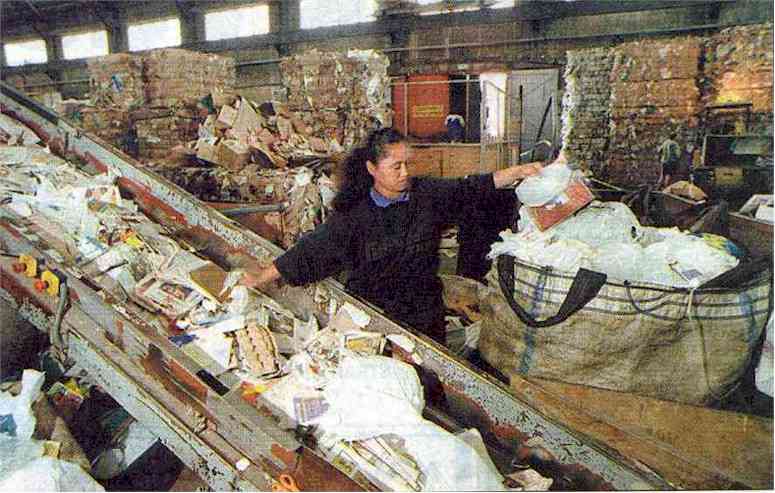

 In Kaitaia, the townsfolk celebrated the closing of their landfill by rolling out the white linen for
an on-site banquet and the launch of a recycling base. Ten years on, the Kaitaia Community Business and Environment Centre says it has turned the tide against senseless
squandering of resources with a 66% reduction in waste carted from the town to the Far North's only big remaining landfill, at Ahipara.
In Kaitaia, the townsfolk celebrated the closing of their landfill by rolling out the white linen for
an on-site banquet and the launch of a recycling base. Ten years on, the Kaitaia Community Business and Environment Centre says it has turned the tide against senseless
squandering of resources with a 66% reduction in waste carted from the town to the Far North's only big remaining landfill, at Ahipara. Zero Waste trust director Warren Snow says local communities are only now waking up to their power to
stop the one-way flow into landfills, and to demand that products are redesigned for greater resource productivity. "They are starting to put their hand over the pipe and say
'enough' - and it is sending shudders all the way up the supply chain." But he is confident of the ability of businesses to respond, despite the difficulty of redesigning entire
production systems built for a throwaway society.
Zero Waste trust director Warren Snow says local communities are only now waking up to their power to
stop the one-way flow into landfills, and to demand that products are redesigned for greater resource productivity. "They are starting to put their hand over the pipe and say
'enough' - and it is sending shudders all the way up the supply chain." But he is confident of the ability of businesses to respond, despite the difficulty of redesigning entire
production systems built for a throwaway society. Christchurch Mayor and taskforce coordinator Garry Moore says there is no shortage of work to be done in
the community, whether it is caring for the environment or for people such as the ill and elderly. The challenge is for the Government to muster the political will to pay a living
wage for work which until now has been under-valued, but which he says is essential for promoting a healthy society. "We are trying to create a public awareness of an issue that
hasn't gone away - we live with unemployed people, we see them walking the streets when they should be at work - their souls are dead."
Christchurch Mayor and taskforce coordinator Garry Moore says there is no shortage of work to be done in
the community, whether it is caring for the environment or for people such as the ill and elderly. The challenge is for the Government to muster the political will to pay a living
wage for work which until now has been under-valued, but which he says is essential for promoting a healthy society. "We are trying to create a public awareness of an issue that
hasn't gone away - we live with unemployed people, we see them walking the streets when they should be at work - their souls are dead." Cliff Colquhoun, general manager of the Kaitaia centre he co-founded with Mr Snow, says it is
constantly struggling for want of adequate Government support after 11 years of trying to promote community development. Although it is hailed as a model of community enterprise,
where few other such organisations have survived for long, he says it could be doing far more with just a modest lift in Government cash. The centre receives only about $45,000 a
year in Government development money, yet returns more than four times that amount in income tax and GST, while spending up to $500,000 in the local economy. It is also saving the
district council at least $75,000 a year on avoided landfill costs, while working in a grey area of profitability under which commercial companies would not find it viable to employ people.
Cliff Colquhoun, general manager of the Kaitaia centre he co-founded with Mr Snow, says it is
constantly struggling for want of adequate Government support after 11 years of trying to promote community development. Although it is hailed as a model of community enterprise,
where few other such organisations have survived for long, he says it could be doing far more with just a modest lift in Government cash. The centre receives only about $45,000 a
year in Government development money, yet returns more than four times that amount in income tax and GST, while spending up to $500,000 in the local economy. It is also saving the
district council at least $75,000 a year on avoided landfill costs, while working in a grey area of profitability under which commercial companies would not find it viable to employ people.