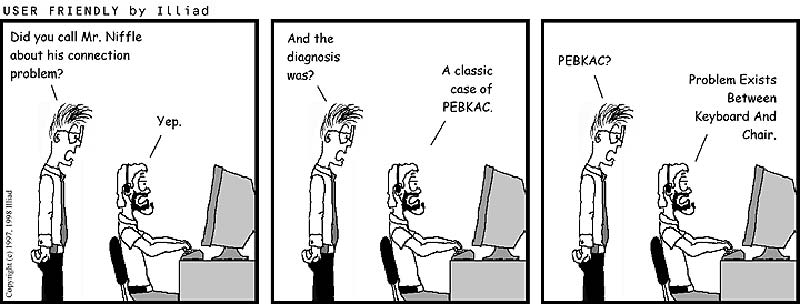
Pebkac
The function of RAM is to give us guys a way of deciding whose computer has the biggest, studliest, most tumescent MEMORY.
This is important, because with today's complex software, the more memory a computer has, the faster it can produce errors.
So the bottom line is, if you're a guy, you cannot have enough RAM.
- Dave Barry


I'd Choose "Extend Weekend"...
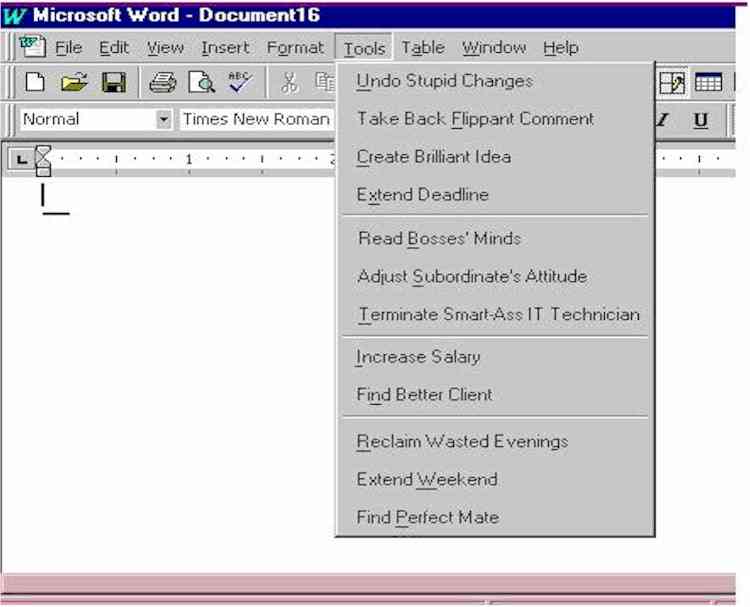
Source: somewhere on the web
Computer Geeks Rule
London - Children who choose to spend time playing computer games may be highly intelligent and destined for high-flying careers rather than introverted failures, according to a
new study. The British Home Office report also says very young children get more aggressive after playing or watching a violent game, though the effects do not
persist. More research is needed, it says, because little evidence exists of long-term effects on the behaviour of children hooked on games.
One study of 127 people, including 63 children, finds that compared with other youngsters, computer geeks are "highly intelligent, motivated and achieving people" who are often
misunderstood. Though a small number of youngsters are in danger of becoming hooked on computer games, it is a harmless dependence, it says. - The Times
Source: The Dominion Monday 26 March 2001
See also:
 | Computers in the Classroom (in the section on Working) - ...the pizzazz of computerised
schoolwork may hide analytical gaps, which "won't become apparent until [the student] can't organise herself around a homework assignment or a job that requires
initiative. More commonplace activities, such as figuring out how to nail two boards together, organising a game ... may actually form a better basis for real-world
intelligence... A dean of the University of Iowa's school of engineering used to say the best engineers were the farm boys," because they knew how machinery really worked... |
| Your Community Is Online (earlier in this section) - the top three search keys used on Lycos were Dragonball, Britney Spears, and tattoos... |
| Cryonics over Dead Geeks' Bodies (in the section on Ageing and Beyond) - What will
people of the future will think about our civilisation when they break open all those canisters containing nerds' bodies and heads? "Instead of preserving the finest
physical specimens of 21st-century humanity - the athletic, the attractive, the physically fit, the Adonis and Venus de Milo types whose bodies are so well deserving of
eternity - we seem to be conserving geeks with taped-up glasses and bad haircuts, people whose idea of dinner ranges only a little further than Frito-Lays, Cheetos and Jolt... |
Computer Viruses: The Good, the Bad and the Ugly
Can computer viruses ever be a force for progress?
In the wild west of the online world, the archetypal baddies are computer viruses and worms. These self-replicating programs are notorious for wreaking havoc in the systems
of unwary users. But, as in the west, not all gunslingers wear black hats. Some virus writers wish their fellow users well, and have been spreading viruses that are
designed to do good, not harm.
Cheese Worm, which appeared a few weeks ago, attempts to fix computers that have been compromised by the Lion Worm. The Lion Worm is dangerous. It infects computers
that use the Linux operating system, and creates multiple "back-doors" into the infected computer. It then e-mails information about these back-doors to people who wish to
misuse that computer for nefarious purposes such as "denial of service" attacks on websites. (Such attacks bombard a site with so many simultaneous requests for access that it
comes out with its hands up.)
That might sound like a good thing. So might VBS.Noped.A@mm. This virus, which arrives as an e-mail attachment, searches a user's hard drive for specific files which
the (unknown) virus writer believes contain child pornography. If the virus finds any files on the proscribed list, it e-mails a copy of the file in question to a random
recipient from a list of American government agencies, with an explanatory note.
The notion of "good" viruses may sound novel; but, according to Vesselin Bontchev, a virus expert with Frisk Software International in Iceland, it is not. However, early
attempts to create beneficial viruses - for example, programs that compressed or encrypted files without asking a user's permission - were resented, because they represented a loss of
control over a user's computer, and a diversion of data-processing resources. Inoculating computers against infection sounds like a good idea, but fails because any unauthorised
changes are suspicious.
Cheese Worm, even though it is designed to help the user whose disk it ends up on, suffers from the same objection. And VBS.Noped.A@mm, whatever social benefits its author
might think it has, is not even meant to do that. If it works, it will harm the user rather than help him. It is little more than cyber-vigilantism. Appropriate to
the wild west, perhaps, but if cyberspace is to be civilised, other solutions will have to be found.
Source: The Economist 16 June 2001
Whatever you do, do NOTclick
here!!
Bugwatch: Malware Comes of Age
The arrival of the true computer parasite
by Dr Jeremy Ward
It is 20 years since Fred Cohen first coined the phrase "computer virus" in his paper Computer Viruses: Theory and Experiments. Since then, the term has been used as a catch-all
for other types of malicious code (or malware), such as worms and Trojan horses. But is it appropriate to use the term "virus" for a piece of computer software? To find out we need
to ask what similarities there are between a biological virus and its software counterpart. While it is clear that the nature of the "virtual" virus is very different from the biological,
there are some similarities.
The strongest resemblance, and that which originally gave rise to the application of the word "virus" to a piece of malicious software code, is that viruses and malware are unable to exist
outside the systems they infect. So malware, like a virus, is definitely a parasite, but is it a successful one? There are three characteristics that demonstrate success in a parasite:
| its ability to spread rapidly and effectively, |
| its ability to infiltrate a host's defences and avoid rapid destruction, and |
| its ability to extract valuable resources from its host. |
With the development of the macro virus, the mass-mailing virus and, more recently, infections that do not require an email to be opened, malware has shown its ability to spread
rapidly and effectively. Malware has also developed the ability to mutate using polymorphic techniques in order to attempt to evade antivirus programs. More recently,
various strains even attempt to terminate antivirus processes and block access to security vendors' websites. Malware is therefore now able to evade its host's defences and
avoid destruction. However, historically there has been no clear mechanism by which malware could extract value from its hosts.
That changed in 2004, taking malicious code to a new peak of evolution as a successful parasite.
It would be fair to say that most end users see a computer virus as something that disrupts operations or destroys data. Without obvious signs of an infection, many users will assume
that they have avoided it. However, with today's evolved malware the real threat is in the bits and bytes that go unnoticed. Indeed, the last three years have witnessed
non-destructive strains increasing from zero to up to 20% of all malware instances. The trend has been statistically very significant, indicating that something important has been
taking place in the malware-writing community.
As with biological parasites, the most successful computer analogies are those that lie dormant until roused by an external stimulus. "Backdoor" malware is of this type, and has
become an increasingly significant phenomenon over the past three years. There are now at least 50 new backdoor malware strains every six months. If malware is becoming less
destructive, and opening more backdoors, then it is fair to wonder about the motivation of its authors. Malware writers have never been known for their public-spirited activity, so if
they are electing not to directly harm our systems there must be something else in it for them.
During 2004, the purpose of backdoor infections has become increasingly clear. For each backdoor that is introduced, an attacker potentially acquires a controllable asset, or
"bot". As their number increases, these bots can be networked into a "botnet" that represents a massive resource in terms of its collective computing power. A piece of successful
malware can potentially give a hacker a botnet consisting of thousands of "zombie" computers. Over the first six months of 2004, the number of computers in botnets rose from under 2,000
to more than 30,000.
Having acquired such resources, hackers can turn them to financial advantage in a number of ways. One established approach is to sell or rent the botnet to spammers as a means of
sending junk mail and bypassing IP address blacklists. Another is to extort money from e-commerce companies by threatening denial of service attacks that can be launched by a botnet
army. Recently we have seen a supply chain emerging. Botnet "herders" will pay hackers for the botnets they have assembled. Such herds can then be sold to organised criminals
for spamming and extortion purposes.
The ability of today's malware to "feed" from infected systems means that we are now able to call computer viruses truly effective parasites. At this point, it is also worth noting
that, since malware can also make money for those that create and exploit it, the threat is worse than it has ever been. The entry of market forces into the world of malware has the
potential to take it to realms at which we can only guess.
Jeremy Ward is a risk consultant for Symantec UK
Source: vnunet.com 17 January 2005
Patents
by Sabra Chartrand
A banking technician harnessed a personal hobby to develop a way to fight computer viruses
Like many people, Claude M Policard has a day job that is strikingly different from his hobbies. He works for a banking service company, where he is a technician helping to maintain
check-processing computers. But he devotes his spare time to music - playing piano and synthesizer, acting as a disc jockey at parties and building a digital archive of music on his
personal computer. A few years ago, his work and his hobby converged in a moment of casual thought. His company had been hit by a nasty computer virus, and Mr Policard remembers
feeling glad he did not have to worry about virus-infested e-mail contaminating his home computer. "I had two computers at home," Mr Policard, who is 65 and lives in Newark, Delaware,
remembered last week. "My sister used one, and I used one. My personal computer I used only for my music, so it will never be attacked by a virus. Right then it came to my
mind. I thought, so why don't I combine the two computers together, but keep them in one case?"
Mr Policard, who was born in Jacmel, Haiti, and grew up in Port-au-Prince, won a patent last week for a two-in-one desktop computer with its own internal barrier to Internet-transmitted
viruses. One hazard of Internet access is the constant vulnerability to viruses that can infect a computer through e-mail. Some viruses are malicious enough to corrupt everything
on a hard drive and wipe out operating systems. For many, the first line of defense against viruses is the refusal to open unexpected or unknown e-mail attachments. But even that
strategy is not foolproof. So Mr Policard created a personal computer that runs with two independent operating systems, two hard drives and two memory banks. The separate systems
isolate personal computing files from Internet data. A user installs software programmes and creates word-processing or spreadsheet files on one hard drive, but gains access to Internet
downloads and e-mail on the second. From the outside, the computer looks like a conventional desktop model. It has one keyboard, one monitor and one mouse. But when it is
turned on, the computer automatically starts up two separate systems. A toggle function allows a user to move between the master computing system and the lnternet computer system.
Mr Policard came to the United States in 1970 after earning a civil engineering degree at the University of Haiti. Because his real interest was electronics, he also took a
correspondence course in computers to learn IBM keypunch and basic programming. Once he moved to New York, he began a career as a computer technician. In his patent, Mr Policard
describes his invention as having the "advantages of two systems without having two desktop computers." His computer has "a case, power supply, motherboard, disk drive, disk drive
interface, monitor, keyboard and can additionally include mouse, printer and CD-ROM-Iike devices." While both internal computing systems share the hardware, the Internet computer is in
contact only with "components that cannot be affected by malicious software. Let's call it a computer with a virus-trap inside," Mr Policard wrote in an early draft of promotional
material for his invention. The Internet computer system can have conventional antivirus software to detect known viruses. But because new viruses emerge all the time, Mr Policard's
system is designed to act as a trap for those viruses the computer cannot identify. "The big advantage of the patent is that any new virus will not pass into the main computer system,"
Mr Policard said last week. His patent says "toggling between the two systems can be accomplished by a switch which can be incorporated into the PC case, or by a third microprocessor using
some keyboard key sequencing to swap between the systems." The third microprocessor could also "monitor the state of both operating systems. If one crashed because of an application
software bug or a computer virus, it would not affect the other because the other system's basic instruction set and stack would still be intact," he wrote.
Even though the computer runs on separate systems, its users are able to transfer data between the master computer and the Internet computer, Mr Policard said.
He is not the first inventor with the idea that one computer should have dual systems. But previous patents cover single systems designed to duplicate data and processing functions,
creating backups so that nothing is lost in the event of either a system or power failure. Mr Policard cites these earlier patents, which were awarded before the Internet became a direct
pipeline into personal computers for e-mail containing viruses. Mr Policard said he wanted to sell or license his invention. "I talked to one computer company, but they told me they
won't look at my idea until I have the patent." he said. Now he has patent Number 6,578,140.
Source: The New York Times Monday 16 June 2003
Patents may be viewed on the Web at uspto.gov or may be ordered through the mail, by patent number, for $3 from the Patent and
Trademark Office, Washington, DC 20231.
Feed the Worms Who Write Worms to the Worms
The Economic Logic of Executing Computer Hackers
by Steven E Landsburg
If we execute murderers, why don't we execute the people who write computer worms? It would probably be a better investment.
Let's do the math. What do we get out of executing a murderer? Deterrence. A high-end estimate is that each execution deters about 10 murders. (The highest estimate I've
ever seen is 24 murders deterred per execution, but the closest thing to a consensus estimate in the econometric literature is about 8.) That's 10 lives saved, with a value - again a high-end
estimate - of about $10 million apiece. (The closet thing to a consensus estimate in the economics literature is about $7 million per life. I am rounding up.) So let's say the
benefit of executing a murderer is roughly 10 times $10 million, or $100 million - and that's probably at the high end.
Compare that to the benefit of executing the author of a computer worm, virus, or Trojan. There seems to be no good name for such people, so I'll make one up - at least until some reader
sends in a better suggestion, I'll call them "vermiscripters." It's estimated that vermiscripting and related activities cost the world about $50 billion a year. So if a single execution
could deter just 1/5 of 1% of all vermiscripting for just one year, we'd gain the same $100-million benefit we earn by executing a killer. Anything over .2%, and any effects that last beyond
the first year, are gravy.
So much for benefits. What about costs? The cost of an execution is one life - usually (one hopes) the life of the guilty, but occasionally the life of a wrongly convicted
innocent. The question is: Which is worth more: the life of the average convicted murderer or the life of the average convicted vermiscripter?
Plausibly, the latter. Compared to murderers, vermiscripters might be easier to rehabilitate (the author of the Sasser worm is, by all reports, still a teenager) and probably have more
skills that can be put to good use. (Offsetting this, though, is the prospect that those same skills can be put to further bad use.) Let's bias things very strongly against the
conclusion I'm driving at by valuing the average murderer's life at zero and the average vermiscripter's life at $100 million - the same value we earlier attributed to 10 lives.
Then to rate the vermiscripter's execution as a better investment than the murderer's, you'd have to expect it to deter at least $200 million worth of computerised vandalism - enough to cover
the $100 million value of executing the murderer plus the $100 million value of the vermiscripter's life. That's twice our earlier estimate, but still just .2% of one year's worth of worm
and virus damage - and still a plausibly easy hurdle to clear.
Conclusion: On a pure cost-benefit basis, we should be quicker to execute a vermiscripter than a murderer. But of course we're not. Which raises the question: Why not?
Here's one answer: "These things can't possibly be reduced to numbers. Who cares if some economist said a human life was worth $7 million or $8 million or $10 million? A chemist
will tell you that the elements in your body have a collective market value of about $10. You might find these numbers interesting in some abstract academic sort of way, but they have nothing
at all to do with making wise policy decisions."
The problem with that answer is that it's wrong. To understand why it's wrong, you have to understand how economists come up with these numbers in the first place. When we say that
a human life is worth $10 million, we mean nothing more or less than this: A typical person, faced with a 1-in-10-million chance of death, seems to be willing to pay about a dollar to eliminate that
risk. We know this not from theory but from observation - by looking, for example, at the size of the pay cuts people are willing to take to move into safer jobs. On this basis, Harvard
professor Kip Viscusi estimates the value of a life at $4.5 million overall, $7 million for a blue-collar male and $8.5 million for a blue collar female. (Viscusi acknowledges that it's
puzzling for a blue-collar life to be worth more than a white-collar life, but that's what the data show.)
If we can deter one random murder in America, we make you a little bit safer: Your chance of being a murder victim shrinks by about 1 in 300 million (because that's how many Americans there
are). If we can execute one killer and deter 10 random murders, the enhancement to your safety is multiplied by 10: Your chance of being a victim shrinks by 1 in 30 million. When we say
that your life is worth $10 million, we mean precisely that you'd be willing to pay about 1/30,000,000 of $10 million - about 33¢ - for that much extra safety. (Actually, you'd probably be
willing to pay slightly less, because each execution, while making you safer on the street, also enhances the risk that you yourself will be falsely convicted and executed someday.)
On the other hand, suppose we can execute one vermiscripter and thereby eliminate, oh, say, 1% of all computer viruses for one year. Assuming that half the $50 billion cost of malicious
hacking is concentrated in the United States and that you bear your proportionate share of that cost, we're putting about 83 cents in your pocket.
Which would you rather have, the safety or the cash? Almost every American would take the cash; that's exactly what we learn from studies like Viscusi's. Executing the murderer means
giving you the safety. Executing the vermiscripter means giving you the cash. You'd rather have the cash than the safety. Ergo, executing the vermiscripter is better policy.
There's one exception to this reasoning: Maybe there's an alternative and less drastic punishment that is highly effective against vermiscripters and not against murderers. If we can
effectively deter malicious hackers by cutting off their supply of Twinkies or crippling their EverQuest avatars, then there's no need to fry them. Whether that would work is an
empirical question.
Some might argue that capital punishment has moral costs and benefits beyond its practical consequences in terms of lives lost and lives saved. Those who make such arguments will want to
modify a lot of the calculations in this column. As for myself, I hold that the government's job is to improve our lives, not to impose its morality. In this, I take my stand with the
president of the United States, who, in a 2000 debate against Al Gore, said quite explicitly that nothing other than deterrence can justify the death penalty.
There's also the fact that all the arithmetic in this column is very much back-of-the-envelope. I implicitly assumed that we're all equally likely to be random murder victims when in fact
some of us (that is, the poor) are more susceptible than others. I used numbers that are rough approximations to the truth. And I probably omitted a consideration or two that I'm sure
I'll hear about from astute readers.
But this essential point remains: Governments exist largely to supply protections that, for one reason or another, we can't purchase in the marketplace. Those governments perform best when
they supply the protections we value most. We can measure their performance only if we are willing to calculate costs and benefits and to respect what our calculations tell us, even when it's
counterintuitive. Any policymaker who won't do this kind of arithmetic is fundamentally unserious about policy.
Steven E Landsburg is the author, most recently, of Fair Play: What Your Child Can Teach You About Economics, Values, and the Meaning of Life. You can e-mail him at
www.landsburg.com
Source: slate.msn.comSlate Wednesday 26 May 2004
"What do we get out of executing a murderer? Deterrence..." So deterrence is the primary goal here? Then, shades of Minority Report, why wait for someone to commit a
crime? Execute the ones who fit the profile. This will have the added effect of removing undesirable genes from the pool.
See also:
| The Burden of Execution - What is "the motive of capital punishment"? Is an execution a rational mechanism - that
is, a tool of deterrence, punishment, or jurisprudence... ? Or is it something altogether different - an expression of an irrational urge far more subterranean than the will to justice? |
Companies Grapple with the Pros and Cons of Workplace Instant Messaging
by Charles Montague
They say that time is money. The faster your employees can do something, the more money you'll make. It ain't rocket science. It's instant messaging.
Why?
Think the written clarity of e-mail with the immediacy of the phone. Then add features such as file sharing, buddy lists and real-time collaboration, and the result is a quick, efficient - and
many would say addictive - way to touch base with clients and colleagues anywhere. Not that employees need to be told this. Some 25 million people use free, consumer-grade instant
messaging programs at work, according to the 2004 Workplace E-Mail and Instant Messaging Survey by the ePolicy Institute and American Management Association. The programmess let users carry on
typed conversations that appear instantly on each other's screens.
"Companies are waking up to the fact that instant messaging (or IM) is being used by their employees," said Jon Sakoda, chief technology officer and co-founder of the software firm IMlogic
Incorporated. Employees chat, share confidential files, swap dirty jokes and catch computer viruses over AOL Instant Messenger, Yahoo, MSN Messenger and IRC. They do it without asking
permission. They do it without their employer's knowledge. And therein lies the problem.
Messages are being transmitted via the public Internet and that can be a huge security liability for companies. Plus, free programs like MSN Messenger don't automatically save
business-related chats. That is required by law in many industries. "Instant messaging is a tremendous potential risk for employers," said Nancy Flynn, executive director of the ePolicy
Institute in Columbus. To address this, business owners first need to realise their employees are instant-messaging, and then adopt policies and install software to manage it. Playing
dumb could leave your company open to security breaches, lawsuits and fines for inadequate record keeping. There are several ways to manage instant messaging among employees, but first it's a
good idea to figure out just how many people are using it.
Flynn recommends scanning your corporate network with one of the many free tools available online. IMlogic offers one on its Web site -
www.imlogic.com - called IM Detector. Once that's done, companies can either ban IM outright or adopt policies to control it. The latter is the best option because, quite frankly, a
ban won't work, Flynn said. "You're likely to have employees who have become very attached to it and they'll continue to download the software and continue to work around whatever blocks you put
up," said the author of Instant Messaging Rules. On top of that, banning IM could aggravate clients who've gotten used to communicating with your employees that way. A more feasible
solution is to install "gateway management" programs, such as those from IMlogic and Akonix Systems Incorporated. These programs basically turn free IM software into corporate-appropriate
software by putting IT departments in total control.
For instance, a company using such a program can monitor, filter, flag, block or save an employee's typed conversation. The programs work with MSN Messenger, AOL Instant Messenger and Yahoo,
in addition to a host of internal messaging programs, such as Lotus Sametime and Reuters Messaging. Gateway management programs also block computer viruses, worms and spim, the IM version of
spam. Both Akonix and IMlogic license their programs for thousands of dollars. However, the price can vary a lot - from $5,000 on up - depending on the number of employees.
Trends and promises of productivity aside, some employers remain skeptical of whether IM is worth the effort. "It began as kind of a black and white issue," said Marcel Nienhuis, a market
analyst for the California research firm the Radicati Group Incorporated. "Some companies were completely for it. Some companies were completely against it. It's still that
way." Those employers may have a point. According to the ePolicy Institute survey, 58% of workplace IM users engage in personal conversations; 16% use it to transmit gossip, rumours and
jokes, and 6% send pornography. Still, Flynn and others insist employees use instant messaging for work, too. But personal conversations are bound to crop up, unless you set clear policies
about what IM should be used for in the workplace. A ban on nonwork-related chats could eliminate the distracting quality of instant messaging. However, it also could upset employees.
"IM is a good way for employees to keep up with their friends and families while they're at work. It could almost be considered a perquisite," said Amanda Lenhart, research specialist for the
Pew Internet & American Life Project. "These are organisations that realise home and work life are blending," she said. "If employees are expected to work late," they need a way to
keep in touch with their loved ones. More than that, employees are beginning to expect it the way they expect to have an e-mail account.
"There's a whole generation now entering the work force that expects instant messaging to be part of the workplace," said Francis Costello, chief marketing officer for Akonix. "They grew up
with it." Bottom line is, instant messaging isn't going anywhere. It's time to deal with it.
Charles Montague is with Knight Ridder Newspapers
Source: freep.com The Detroit Free Press Monday 17 January 2005
For IT-related articles on snooping, usage, the future, e-diaries, piracy, flickers, cyborgs, browsing, trends, jokes, philosophic agents, artificial consciousness and more, press the "Up" button
below to take you to the Table of Contents for this Information and Technology section.
|
 Animals
 Animation
 Art of Playing Cards
 Drugs
Drugs Education
 Environment
 Flying
 History
 Humour
 Immigration
 Info/Tech
 Intellectual/Entertaining
 Lifestyles
 Men
Men Money/Politics/Law
 New Jersey
 Odds and Oddities
 Older & Under
 Photography
 Prisons
 Relationships
 Science
 Social/Cultural
 Terrorism
 Wellington
 Working
 Zero Return Investment