Animals
 Animation
 Art of Playing Cards
 Drugs
Drugs Education
 Environment
 Flying
 History
 Humour
 Immigration
 Info/Tech
 Intellectual/Entertaining
 Lifestyles
 Men
Men Money/Politics/Law
 New Jersey
 Odds and Oddities
 Older & Under
 Photography
 Prisons
 Relationships
 Science
 Social/Cultural
 Terrorism
 Wellington
 Working
 Zero Return Investment
Blow Me Away
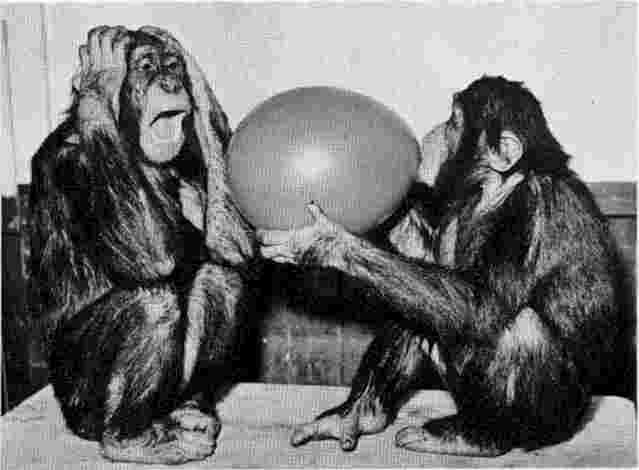
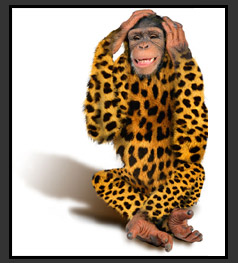
Don't Blow It!Once I saw a chimpanzee gaze at a particularly beautiful sunset for a full 15 minutes, - Adriaan Kortlandt
Source: Fox Photos as appeared in Cyclists Please Dismount and Other Photographs from Kodak Limited's "Humour '70" Exhibition For more information about the growing body of knowledge regarding the human-like qualities of apes, please see Waiting for a Turn further on in this section.
Modern-Day Frankensteinby Lawrence Hall Robert White, a scientist in Cleveland, recently told the British Broadcasting Corporation that he transplanted a monkey's brain into another primate and that the animal survived for a while after the operation. He didn't say where he conducted this grotesque experiment. White said his team was able to "transplant the brain as a separate organ into an intact animal and maintain it in a viable, or living, situation for many days. We've been able to retain the brain in the skull and in the head." He claimed that the monkey was conscious and capable of experiencing sensation since the nerves in its head were intact. White believes brain transplants could one day be used to treat paralysed people. But some British medical researchers view his claim as preposterous and his experiment as highly unethical. "This is medical technology run completely mad and out of all proportion to what's needed," says Dr Stephen Rose, director of brain and behavioral research at the Open University. Such an experiment, Rose says, is "scientifically misleading, technically and scientifically irrelevant and, apart from anything else, a grotesque breach of any ethical consideration." Source: The Star-Ledger (New Jersey) Wednesday 16 May 2001
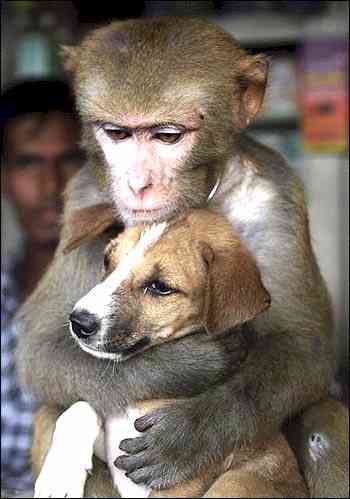
A Pet's Pet
A female monkey fondly cuddles a puppy at a shop in the Bangladeshi capital Dhaka, 9 May 2002. Source: channels.netscape.com from Reuters photo credit Rafiqur Rahman
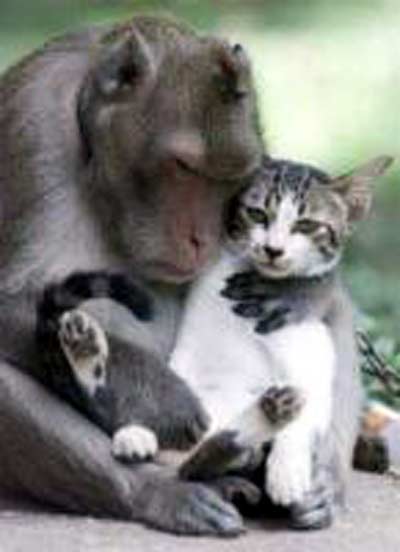
Source: greenapple.com
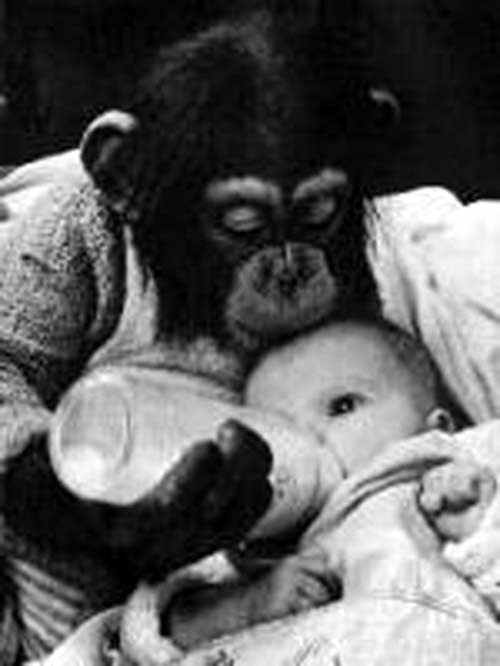
This One I Find a Wee Bit Disturbing...
Source: also greenapple.com I have great respect for chimps but, dress them up in clothes as you will, they are still wild animals and, as such, have possibilities of unpredictability. I think I would find a different babysitter if it were me. See also:
Gorilla at an Illinois Zoo Rescues a 3-Year-Old BoyA 3-year-old boy fell into an exhibit occupied by gorillas at the Brookfield (Illinois) Zoo, and was rescued by a female gorilla that cradled the child and brought him to zookeepers; the boy injured his head when he fell 18 feet onto the exhibit's concrete. Source: New York Times Saturday 17 August 1996 Sec 1 Pg 7 Col 5
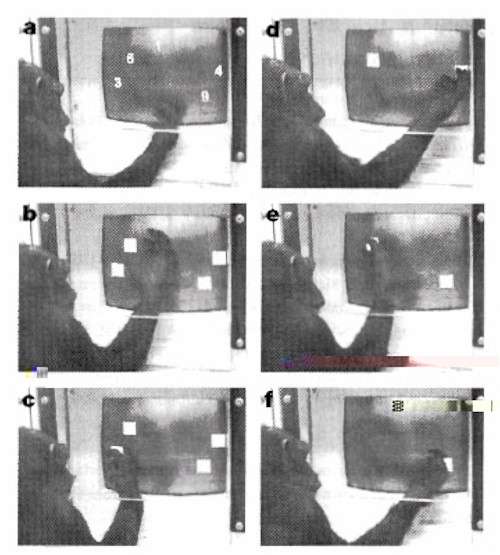
Numerical Memory Span in a ChimpanzeeA female chimpanzee called Ai has learned to use Arabic numerals to represent numbers [1]. She can count from zero to nine items, which she demonstrates by touching the appropriate number on a touch-sensitive monitor[2, 3], and she can order the numbers from zero to nine in sequence[4, 5, 6]. Here we investigate Ai's memory span by testing her skill in these numerical tasks, and find that she can remember the correct sequence of any five numbers selected from the range zero to nine.
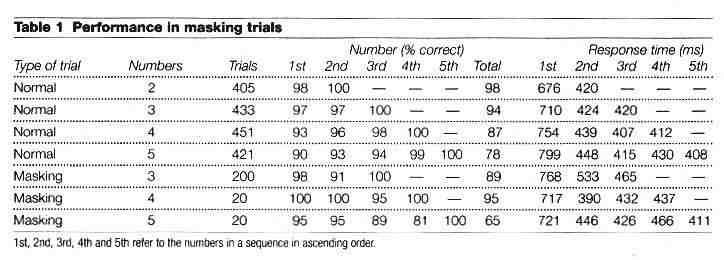
The chimpanzee Ai performing the 5-number ordering task in the "masking" trial. Humans can easily memorise strings of codes such as phone numbers and postcodes if they consist of up to seven items, but above this number they find it much harder. This "magic number 7" effect, as it is known in human information processing [7], represents a limit for the number of items that can be handled simultaneously by the brain. To determine the equivalent "magic number" in a chimpanzee, we presented our subject with a set of numbers on a screen, say 1, 3, 4, 6 and 9. She had already displayed close to perfect accuracy when required to choose numerals in ascending order, but for this experiment all the remaining numbers were masked by white squares once she had selected the first number. This meant that, in order to be correct in a trial, she had to memorise all the numbers, as well as their respective positions, before making the first response. Chance levels with three, four and five items were 50, 13 and 6%, respectively. Ai scored more than 90% with four items and about 65% with five items, significantly above chance in each case. In normal background trials, response latency was longest for the first numeral and much shorter for all the others, indicating that Ai inspected the numbers and their locations and planned her actions before making her first choice. In masking trials, response latency increased only for the choice directly after the onset of masking, but this latency was similar to those recorded in background trials, indicating that successful performance did not depend on spending more time memorising the numbers. In one testing session, after Ai had chosen the correct number and all the remaining items were masked by white squares, a fight broke out among a group of chimpanzees outside the room, accompanied by loud screaming. Ai abandoned her task and paid attention to the fight for about 20 seconds, after which she returned to the screen and completed the trial without error.
Ai's performance shows that chimpanzees can remember the sequence of at least five numbers, the same as (or even more than) preschool children. Our study and others [8, 9, 10] demonstrate the rudimentary form of numerical competence in nonhuman primates. Nobuyuki Kawai, Tetsuro Matsuzawa [1.] Matsuzawa, T Nature 315 57 - 59 (1985). [2.] Matsuzawa T, Itakura S & Tomonaga M in Primatology Today (eds Ehara A, Kumura T, Takenaka O & Iwamoto M) 317 - 320 (Elsevier Amsterdam 1991) [3.] Murofushi K Japan Psychology Research 39 140 - 153 (1997) [4.] Tomonaga M, Matsuzawa T & Itakura S Primate Research 9 67 - 77 (1993) [5.] Biro D & Matsuzawa T Journal of Comparative Psychology 113 178 - 185 (1999) [6.] Tomonaga M & Matsuzawa T Animal Cognition (in the press) [7.] Miller G A Psychology Review 63 81 - 97 (1956) [8.] Rumbaugh D, Savage-Rumbaugh, E S & Hegel M Journal of Experimental Psychology Animal Behaviour Processes 13 107 - 115 (1987) [9.] Brannon E & Terrace H Science 282 746 - 749 (1998) [10.] Boysen S, Mukobi K & Berntson G Animal Learned Behaviour 27 229 - 235 (1999) Supplementary information is available on Nature's website or as paper copy from the London editorial office of Nature. Source: Nature Vol 403 6 January 2000
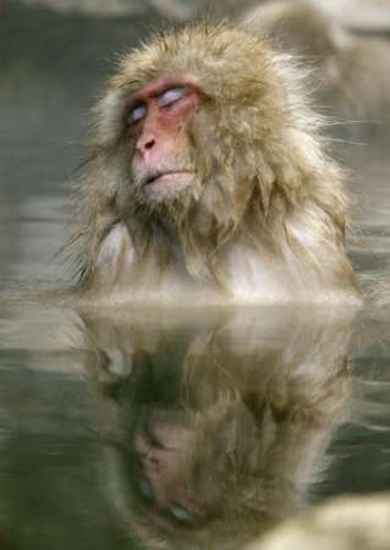
At the Spa
A Japanese monkey closes its eyes as it bathes in a hot spring in a valley
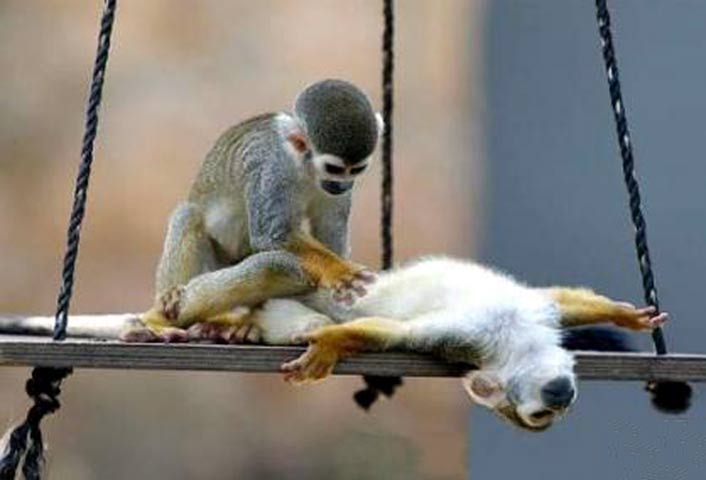
And the Masseuse
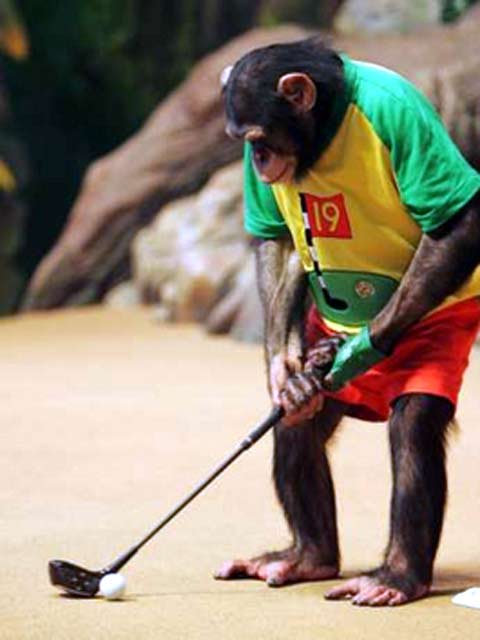
Golfing: Taking a Chimp Shot
Seven-year-old trained chimpanzee, Rudi, plays golf during "the animal wonder
Nuts to Healthy LivingNote: If Cheeta's extraordinary age seems fantastic - it may very well be too good to be true. See the story. "Monkey Business: Is Tarzan's Chimp Cheeta a Cheater?" near the end of this page... Tarzan's chimp is still alive and kicking, but he's had to give up booze and cigars
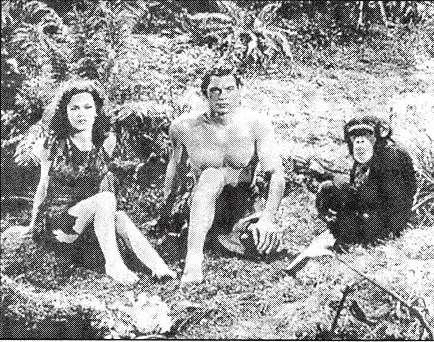
Cheeta the chimpanzee, the animal star of 12 Tarzan films in the '30s and '40s, celebrated his 75th birthday yesterday. by Ronald Atkin He was a movie star by age two, went on to have a 30-year film career and now lives in comfortable retirement as Bob Hope's neighbour in California where he is admired as a prominent local artist. Not at all bad, for a chimpanzee. The chimp, Cheeta, played alongside Johnny Weissmuller and Maureen O'Sullivan in the classic Tarzan series of the 30s. The film has just been re-released, so Cheeta is back in the limelight. Not surprisingly, he's the world's wealthiest chimp. He's also one of the oldest - 67, but he doesn't look a day over 40. Until his retirement in 1967 Cheeta had virtually cornered the market in chimp roles - he starred in 12 Tarzan films and also worked with Bela Lugosi and Rex Harrison. Fans still shed a tear over his final cameo performance alongside Rex Harrison in Doctor Dolittle in 1967.
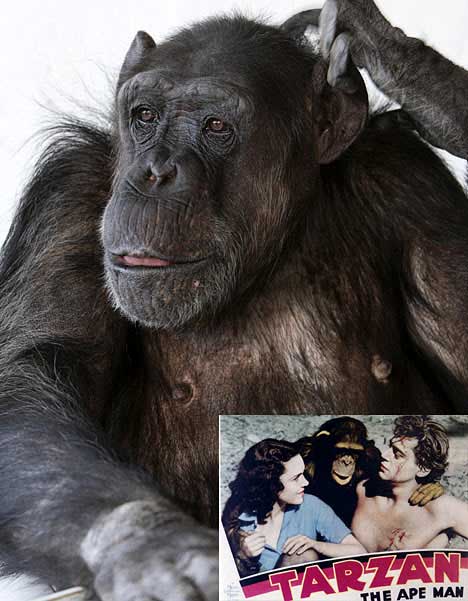
Old Ape - Cheetah today, and below, with Johnny Weissmuller and
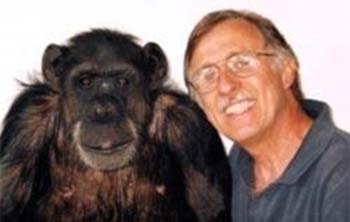
In the United States, youngsters are falling over themselves to learn about the "real" Cheetah, and tour buses now drive past his house in Palm Springs in the hope of catching a glimpse of the great star. The guides say there is almost as much interest in Cheetah as in his close neighbours Bob Hope and Kirk Douglas. Cheetah lives with his companion and owner, actor Dan Westfall, who says he is honoured to share a home with the "last of the simian icons." Home, "Casa de Cheetah," also provides shelter for a multitude of apes, dogs, snakes and birds. The weekly pet food bill is in the region of $500. Cheetah, who worked with Weissmuller and O'Sullivan (as Jane) on 12 Tarzan films, was inherited by Westfall from his uncle, Tony Gentry, an animal trainer who went to work in Hollywood in the 1930s with animal expert Frank Buck. Gentry went to Africa to find chimps with movie potential and discovered Cheetah. Cheetah, who is still alert but taking things easy on account of his age, still gives interviews. He doesn't actually speak English, but, claims Westfall, can understand what is said to him. The interview begins with the star slumped on the sofa watching tv. "Put your feet down while you are watching tv," suggests Westfall kindly. Cheetah does as he is advised. "Blow your nose," is the next command. Cheetah takes out a hankie. Once comfortable, the chimp takes a can of soft drink and expertly opens it, before nodding as Westfall elaborates on the secret of Cheetah's success. For starters, there are cigars and booze. He likes both, or at least he did before Brigitte Bardot poked her nose in. The animal rights campaigner complained that they could do damage to Cheetah's health and threatened protests and demonstrations. So, Cheetah was denied his little pleasures. But he's still allowed his favourite food of burgers and chips along with monkey chow and fruit. These days he prefers to stay at home watching old films, especially his own, on tv, but on special occasions can be seen at his own table at McDonald's. He doesn't do as much painting as he once did. Works in his "apestract" style fetch between $NZ250 and $2,000 apiece. A couple of years ago he held a joint exhibition at London's National Gallery with human artist Peter Blake, of Sgt Pepper album cover fame. Chimps usually die before 50 so Cheetah appears to be a good ad for the a-little-bit-of-what-you-like-does-you-good philosophy, although at 82kg he is a little on the heavy side for his height - 1.37m (4ft 6in). - The Independent Source: The Evening Post Wednesday 10 November 1999
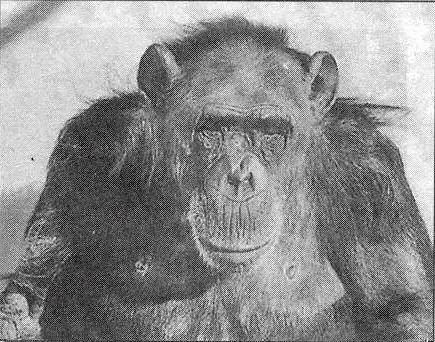
Male monkeys lose the hair on their heads in the same way men do. You can really see that by looking at the elderly Cheeta's photograph above. Actually, his name is (was?) Jiggs and he has produced over 100 paintings. But does he weigh 180 or 140? Is he 4 feet tall or 4½? As you can see, this chimp is a bit of an enigma...
Tarzan's Cheeta's Life as a Retired Movie Starby John Roach Many Hollywood stars retire in the oasis of Palm Springs, California where they while away their golden years splashing paint on canvases, taking leisurely strolls, playing the piano, and flipping through the pages of magazines. Such is the life of 71-year-old Cheeta, the chimpanzee of Tarzan fame who celebrated his birthday a month ago. "He's the world's oldest chimp and in excellent condition," said Dan Westfall, who cares for Cheeta and several other retired showbiz primates at the Cheeta Primate Foundation in Palm Springs. Cheeta's "world's oldest" title is noted in the Guinness Book of World Records. Chimpanzees in the wild tend to live for 40 to 45 years and to the mid 50s in captivity, according to chimpanzee researchers. Activists for the proper care and treatment of chimpanzees and other nonhuman primates applaud Cheeta's age record, but caution against celebrating the lifestyle of chimpanzees that were stars in the entertainment industry. "Would you go to a movie if you knew the child actors had been kidnapped and been forced through abuse by their kidnappers to perform silly, demeaning acts?" asks Roger Fouts, co-director of the Chimpanzee and Human Communication Institute at Central Washington University in Ellensburg. Activists say that retired entertainment chimpanzees engage in human behaviours such as watching television and reading magazines because they were deprived of a natural lifestyle and were instead trained to behave like humans, often through physical abuse. "You don't have to be a rocket scientist to know that they are pretty dysfunctional," said Gloria Grow, co-founder of the Fauna Foundation which cares for neglected and abused animals in Quebec, Canada. For example, Grow said that several of the chimpanzees in her foundation's care, including those that were in the entertainment industry, do not know how to have intercourse or how to look after their young. "It is common scientific knowledge that taking mothers from babies has very serious consequences for the psychological well-being of both the mother and the infant, yet this is what happens to every trained chimpanzee," said Fouts. Abe Karajerjian, a biological anthropologist who works with Westfall in the caretaking of the animals at the Cheeta Primate Foundation, says Cheeta and his companions are provided with an environment and social structure that is more suitable to their species rather than perpetuating their human-like lifestyles and behaviours. "We just love them and love to do things for them," he said. "They made tons of people happy, they had to endure a lot to make people happy, and we want to give back to them, provide them with friends." Westfall, a comedian and actor, adopted Cheeta about 10 years ago from his uncle Tony Gentry, an animal trainer who worked in Hollywood and discovered Cheeta while on an animal talent scouting trip to Africa in the 1930s. The 4 foot (1.2 meter) tall, 142 pound (53 kilogram) chimpanzee starred in 12 Tarzan movies and had his last role 36 years ago in the 1967 musical film Doctor Doolittle. Cheeta now spends his days socialising with other apes and human caregivers. At times he seems fascinated by looking at other animals on television and in the pages of magazines like National Geographic, said Karajerjian. On a few occasions the media has spotted Cheeta taking a ride in the car with Westfall, who said that Cheeta "likes to go through the drive-thru and get a hamburger and a Coke." Cheeta's staple diet consists of fresh fruit, vegetables, and monkey chow, which is a nonhuman-primate version of dog food. In his earlier years Cheeta had a penchant for beer and cigars, reportedly drinking several cold ones a day. Westfall and Karajerjian said booze and smoke have not been a part of the old chimp's life since he came into their care 10 years ago. "Where he lives now nobody smokes and drinks," said Karajerjian. "I hate smoking and drinking and so why would I offer it to apes?" At the sanctuary the apes are provided with a variety of activities to stimulate their intellect and curiosity. One of the activities is painting, which Karajerjian says allows chimpanzees to mimic their innate behavior of inventing and using tools. Westfall says that Cheeta has developed a particular talent as an abstract artist and has trademarked Cheeta's creations as "Ape-stract." Cheeta uses a paintbrush and bright colours for his creations which are full of sweeps, swirls, and straight lines. "They are very pretty, actually," said Westfall, who sells his companion's work for $125 a piece. The proceeds go to support the Cheeta Primate Foundation, which Westfall started to raise money for unwanted showbiz animals. Cheeta is a rarity among chimpanzee actors in that he was used for films into his 30s. "Most of the chimpanzees used in the entertainment industry are used when they are quite young," said Rick Bogle of the Primate Freedom Project in Santa Barbara, California. The organisation works for the protection of nonhuman primates. Chimpanzees rarely act beyond the age of 10 because they become less manageable and less willing to follow directions, said Bogle. When the chimpanzees are retired, many of them are sold into biomedical research. Gentry, Cheeta's previous owner, feared a research laboratory was Cheeta's destination so he had asked in his will that Cheeta be put to rest. Westfall talked his uncle out of having Cheeta put to rest by promising to take good care of the chimp. Ex-entertainment chimpanzees are unfit for zoos, said Fouts, because they do not behave like regular chimpanzees. "And often times they are not socialised to other chimpanzees so they would be difficult to integrate into a social population," he said. Westfall said primate researcher Jane Goodall inspired him to start the foundation for unwanted showbiz primates. The other chimpanzees, orangutans, and monkeys in his care have starred in television commercials, nightclubs, and theatres, but none reached the star status of Cheeta. "There are also some from labs that we'd love to get sometime to save their lives and give them a good, healthy home to live in," he said. All of the animals in Westfall's care interact on a daily basis and with each other and their human caregivers. Westfall's house is not open to the public, but tour buses and children often stop in front where there is a statue of Cheeta. Terry Wolf, wildlife director at Lion Country Safari in Loxahatchee, Florida, which cares for about 35 chimpanzees, said that captive chimpanzees that were picked up from the entertainment industry and research facilities are living longer because humans are taking better care of them. "The quality of health care and diet in the past was traditionally not all that great," he said. Now humans have a better understanding of chimpanzee dietary, physical, and social needs, including the need for interaction to prevent the onset of deadly bouts of depression. Little Mama, a chimpanzee who starred in a travelling ice skating show before coming to Lion Country Safari in 1967, is thought to be 65 years old and like Cheeta is in good health. She is social and gets along well with her mates, who she lives with on a series of islands in the drive-through zoo, said Wolf. "Old age is something to be celebrated," said Virginia Landau, director of the Jane Goodall Institute's ChimpanZoo in Tucson, Arizona, which coordinates the study of chimpanzees in zoos and other captive settings. Donations or a request for a piece of Cheeta's Ape-stract art can be sent to Westfall: Dan Westfall Source: news.nationalgeographic.com National Geographic News 9 May 2003
Me Cheeta: The Autobiography
Cheeta the chimp at home in Palm Springs, California Reviewed by Lynne Truss Many points are so beautifully made in this excellent spoof of a Hollywood memoir that it is honestly hard to know where to start. But one could usefully begin with Cheeta's incisive contribution to the "infinite number of monkeys" theory of probability. It's all very well hypothesising about those monkeys and typewriters, he says: isn't it time for human beings to look around? "You've had a million humans, at least, writing away for much longer than 1,000 years, and only one of them ever managed to produce the Complete Works of Shakespeare. Only one! Well, well, what's the big deal?" Books that are narrated by animals (or even randomly typed by one famous chimpanzee) tend to divide opinion from the outset. I know this because I often recommend Caroline Alexander's Mrs Chippy's Last Expedition - a cat's-eye view of Shackleton's Endurance as it cracked and broke under the pressure of polar ice - and I've seen a lot of people's eyes roll back in their heads at the sheer whimsicality of the idea. But sometimes an animal's viewpoint is illuminating, surely? In Mrs Chippy's case, here are men in extremis, trying to keep calm. The presence of the cat reminds them of their humanity. Similarly, look at the great shrieking jungle that was Hollywood in its heyday, and who better to understand it than a grizzled old showbiz chimp with an in-built Darwinian perspective? "What does any organism ever do except - survive?" writes Cheeta. "In this business, if your profile ever drops, you're dead." What we have here is a showbiz memoir from a star whose gilded cage was no metaphor; who views the great days of Hollywood in zoological terms. It's a brilliant idea. Naturally, as befits the memoir genre, Cheeta defines himself as an actor ("I'm a comedian, not an intellectual"). Naturally, too, modesty does not prevent him from pointing out that, in his great middle-period work on the Tarzan pictures, he was a pioneer of "simian thespianism". How much of his success in films was down to him being an animal? Cheeta will accept it's as much as 10%; the rest, however, was talent. In common with every other showbiz memoirist, he claims never to read his reviews; he then quotes them extensively. He mentions several times that he never won an effing Oscar. He will recall a great star such as Rex Harrison by first calling him "that marvellous light comedian", then getting down to the more interesting truth ("universally despised, impotent, alcoholic"), before coming properly out with it: "an absolutely irredeemable c*** who tried to murder me". And, like many another stellar memoirist, he can't resist a vicious sideswipe at a fellow thesp. "For three decades I think I ‘phoned it in' a bit," he confesses. "It happens to actors. Look at De Niro." What justifies the whole enterprise is that the screen myth of Tarzan is rooted in the tussle between innocence and experience. A plane crashes in a jungle, and a human baby is raised by apes to know nothing of the corrupted world beyond - where the gang-rape of starlets is covered up by studio hoodlums, for example, and where Mary Astor ("dear, sweet Mary Astor") is secretly addicted to the erect male sexual organ. In every Tarzan movie, visitors try to lure Tarzan back to "civilisation", but he resists. What drives this book is the way Cheeta - an animal within the civilised world; a civilised soul in a bestial one - clings for sheer life to the notion of humankind's innate nobility. Basically, he jumps into our arms and clings on. Despite all he's seen of debauched Hollywood mating rituals, despite snorting cocaine from the naked breasts of Constance Bennett, Cheeta still believes in the superiority of humans, personified in the great Johnny Weissmuller, the gentle "alpha" giant he adored. "Johnny Weissmuller was a great, great silent-movie star - a transmitter of joy, a transmitter of sorrow. You looked at him and thought - the rest of us? We're just beasts." This is a hilarious book, packed with well-aimed Swiftian turds ("Everything was dream-sharp and sparkling, like Beverly Hills in Cary Grant's LSD-inflected eyes"; "If Marlene Dietrich was a ‘good' German, I thought, then the bad ones must be absolutely f***ing terrifying"), but what stands out from it is Cheeta's enduring love for his humble Tarzan: it brings out the pity in both their stories. Cheeta, the gurning chimp; Johnny, the beautiful human - well, neither of them had a choice about working with Maureen O'Sullivan, did they? Cheeta recalls seeing Louis B Mayer bullying Johnny, "Who the hell do you think you are, you bum? Lillian Gish? Get it through your head - you're Tarzan! You're never going to be anybody but Tarzan!" And it is like seeing a trainer strike a defenceless animal with a crowbar. Towards the end of the book there is a heartbreaking reunion between the two ageing co-stars, contrived by others for profit, and I can only say, I'm glad a movie of this book is impossible, because it would be absolute agony to watch. Nowadays, Cheeta lives in Palm Springs with a companion, Dan, who gives him insulin injections and generally protects his existence. While other stars have died on the scrapheap (including Johnny), Cheeta has lived on. He paints pictures; he writes books; he rehearses his Oscar acceptance speech; he continues to insist that he never had sex with Dolores del Rio. Me Cheeta is a terrific book; the only thing one could possibly lament is the absence of a comma in the title. Vivid, funny and clever, it will subtly change forever the way we think not only about Hollywood (and actors' memoirs) but also about our very species. I have no idea who really wrote it, by the way (the publishers are keeping that to themselves), but I'm fairly confident that an infinite number of untalented people could not have achieved it by accident - or not in less than a million years, anyway. Me Cheeta: The Autobiography Source: entertainment.timesonline.co.uk The Sunday Times 5 October 2008
Monkey Business: Is Tarzan's Chimp Cheeta a Cheater?
Research has led to doubts as to whether Cheeta is the chimp from the Tarzan films. Photo source: Rebel Images / Rex Features by David Leafe When he celebrates his 77th birthday in a few days' time, one of Hollywood's oldest icons will greet well-wishers and reporters at his home in Palm Springs, the desert resort 100 miles from Los Angeles where celebrities like Frank Sinatra, Bob Hope and Dean Martin once sought relief from the pressures of stardom. In place of the beer and cigars he enjoyed in his youth he will be given a sugarfree cake to avoid aggravating his diabetes, and the proceedings will involve nothing more flamboyant than the singing of Happy Birthday beside the swimming pool. But the lack of glitz should fool no one - for Cheeta the chimpanzee, is still undoubtedly a star. Decades after he appeared in the Tarzan films, busloads of tourists still drive by his home, his "memoirs" recently received rave reviews in the UK. The campaign for him to be awarded a star on the prestigious Hollywood Walk of Fame has been backed by Hillary Clinton among other notables. These seem fitting tributes for a creature recognised by the Guinness Book Of World Records as the world's oldest living simian. But even as newspapers worldwide prepare to marvel again at his continued survival, just as they have on so many of his recent birthdays, a troubling question has emerged: is the world's most famous chimp a Hollywood fraud? Recent investigations suggest Cheeta cannot be as old as claimed and certainly isn't the chimp who appeared in the early Tarzan films. If this is true, the world's favourite animal film star is an impostor. The story of Cheeta's life which has been accepted until now relies heavily on the accounts given by his first owner, Hollywood animal trainer Tony Gentry. He claimed to have acquired him as a baby chimpanzee during a visit to Liberia in West Africa in 1932, hiding him under his jacket and smuggling him aboard a Pan Am flight back to America. Although Cheeta's real birthday is not known, Gentry always celebrated it on 9 April, the anniversary of the day he landed in the US. According to Gentry, this followed an eventful journey during which the infant Cheeta scampered up and down the aircraft's aisle wearing nappies and had to be subdued - after driving the stewardesses hysterical - with a warm bottle of milk. Gentry claimed that his baby chimp's empathy with humans and love of the limelight made him a natural choice to star alongside the former Olympic swimmer Johnny Weissmuller, who took the title role in the 1934 film Tarzan And His Mate. Tarzan's chattering sidekick quickly became one of the biggest animal stars of his day, the simian world's answer to canine celebrities like Rin Tin Tin, although his fans did not include the late Maureen O'Sullivan who played Weissmuller's love interest Jane. "Monkeys are nice until they're about 3 years old," she once told an interviewer. "After that, they do get mean."
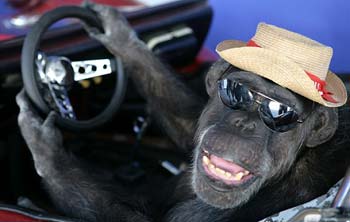
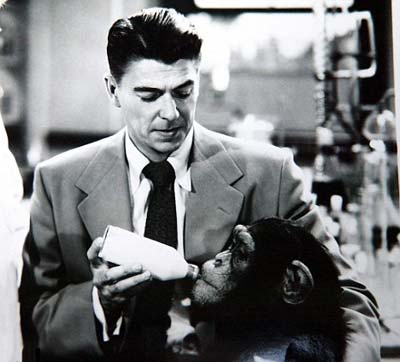
Cheeta appeared with the late President Ronald Reagan in the 1951 film Bedtime for Bonzo After appearing in 12 Tarzan films, Johnny Weissmuller gave his last roar as the character in 1948, but the co-star's film career was far from over, according to Tony Gentry's version of events. In 1951, Cheeta is said to have performed alongside Ronald Reagan in the comedy Bedtime For Bonzo, allegedly walking off set when Reagan kept forgetting his lines. His diva-like behaviour was still apparent more than a decade later, according to Gentry, when he played Chee-Chee the chimp in Doctor Dolittle, reportedly biting the finger of its star Rex Harrison during filming. This supposedly marked Cheeta's swansong as an actor and, as owner and ape grew older, they retired to a suburb of Los Angeles. There, Cheeta fascinated visitors with his human-like behaviour - playing the piano, twirling spaghetti with a fork and drinking brandy from a glass with his little finger daintily outstretched. The bond between man and beast was so close that Cheeta was rumoured to have pushed Gentry around in his wheelchair when he became too debilitated to wheel it himself. Nearing the end of his life in 1991, Gentry was convinced no one could care for Cheeta as he had and he stipulated in his will that the chimpanzee should be put down after his death. The story might have ended there, with Cheeta's legend intact, had it not been for the intervention of Gentry's nephew, Dan Westfall. Once an animal trainer like his uncle, he had become disenchanted with an industry in which chimpanzees less fortunate than Cheeta were often cruelly exploited to entertain humans. Westfall persuaded his uncle to let him care for Cheeta and, with the encouragement of the renowned primate expert Dr Jane Goodall, he set up a sanctuary for showbusiness apes and monkeys at his home in Palm Springs, where Cheeta's life has taken a series of ever stranger twists in the years since. Apparently living far beyond the 50 years which is the average life span for a chimpanzee, he has developed a successful career as an artist, his "apestract" paintings selling for upwards of £100 each. The money goes to fund Westfall's non-profit-making sanctuary. Celebrity fans of his work include Carol Channing of Hello, Dolly! fame, and Lord Montagu of Beaulieu. In 2007 his work was even exhibited in the National Gallery in London. That same year, Cheeta reached what was claimed to be his 75th birthday and the festivities included the ultimate accolade, the screening of a video message from Jane Goodall who hooted Happy Birthday to him in the raucous language of wild chimps. Short of winning an Oscar for Best Supporting Primate, it seemed the chimp's star could rise no higher. But then last year came news that Cheeta planned to release a single - a cover version of the song "Convoy", the anthem of CB radio users in the '70s. Although the song has still to be recorded, it was reported that the accompanying DVD would show Cheeta wearing sunglasses and his favourite straw hat while driving a jeep and ogling bikini-clad women. This announcement was followed by the publication last autumn of Me Cheeta - a book purporting to be his autobiography. The work of an English ghost-writer, its tongue-in-cheek revelations included the suggestion that Cheeta once acted as a body double for the famously hirsute actor and comedian Robin Williams. Although favourably reviewed, the book had not been authorised by Dan Westfall or, indeed, Cheeta himself. Even so, it might have been better for both if it had stood as the sole record of the chimp's life, for it was Westfall's efforts to commission an official biography which have led to questioning of Cheeta's story. Towards the end of 2007, Westfall's agent approached American author Richard Rosen with the idea of writing the biography. Later admitting he was dazzled by the agent's claim that she "never gets out of bed for less than a quarter of a million dollars", Rosen was initially excited about the project. But then some often-repeated facts about Cheeta's life began nagging at him. First there was Tony Gentry's claim about bringing Cheeta back to America on that Pan Am flight in 1932. Rosen's research showed that there were no transatlantic airline services until 1939. Next was the suggestion that Cheeta had played Chee-Chee in Doctor Dolittle. Although this had been supported by numerous newspaper stories since, Rosen watched a DVD of the movie and was puzzled to see that Chee-Chee was portrayed by a juvenile chimpanzee who was clearly no older than 8. Since the film was made in 1966, by which time Cheeta would have been at least 34 by Tony Gentry's own account, this could not be the same chimp that starred with Johnny Weissmuller in the Tarzan epics. The same was true of Bedtime For Bonzo in which the title role was played by an infant chimp, far younger than Cheeta who was supposedly 19 at the time. Desperate to salvage his book, Rosen went to bizarre lengths to prove that the Cheeta known to Johnny Weissmuller and Tony Gentry were one and the same. His investigations showed Tarzan had not just one Cheeta but a whole pack - the role played by different chimps depending on what talents were required in a particular scene. Reasoning that all might not be lost if Gentry's Cheeta appeared in at least one of the movies, Westfall rented DVDs of every Tarzan film he could find and began freeze-framing on every close-up of the chimp. Just as in humans, chimpanzees' faces change considerably as they age but the shape of their ears changes very little, so Rosen compared the ears of all Tarzan's chimps to those on a photograph of Tony Gentry's Cheeta. Many days and thousands of ears later he had failed to find a single match. If Gentry's Cheeta was a fake, then what had happened to the many chimps who really played the part of Tarzan's companion? Sadly, they may have shared the fate of many faded showbiz chimps - consigned to a life of abuse as part of touring sideshows and circuses or sold off to research laboratories. As for the question of who Gentry's Cheeta really was, Rosen turned to animal trainers who had known Tony Gentry well. They told him Cheeta had once been an attraction at an amusement park on the pier at Santa Monica, to the south of Los Angeles, and was sold when it closed in 1967. He was then only 6 or 7 so he was born in 1960 at the very earliest - far too young to have been in the Tarzan movies or even Bedtime For Bonzo. Although he might still be in the frame for Doctor Dolittle, given the validity of his other claims it seems unlikely. Asked why Gentry would have pretended otherwise, his fellow trainers recalled his fondness for embellishing the truth. "When Tony told his stories, everybody would roll their eyes," said one. "He just took credit for things he didn't do." All the evidence now pointed to Cheeta being a fraud, but Rosen hesitated to tell Dan Westfall about his research. He had come to like Westfall and believed he had unwittingly inherited the lie about Cheeta from his highly imaginative uncle. Although he had since taken in a number of other animals, including baboons and macaques, Westfall regarded the chimp almost as a son. Giving him twice-daily insulin shots to combat his diabetes, he drove him to McDonald's once a week for his favourite treat of cheeseburger, fries and Diet Coke. He had named his home Casa de Cheeta in his honour and even erected a bronze statue of him on the front lawn. Westfall was devastated when Rosen eventually told him the news about his favourite charge, but relations between the two men remained cordial. At Westfall's request, Rosen helped him change the wording on Cheeta's website, cheetathechimp.org, to reflect the doubts that had been raised about his origins. He then hoped to persuade him to co-operate on a different kind of a book - about the myths created in showbusiness and how in Hollywood even the animals lie about their age, but Westfall has since declined, saying it was all too painful. All of this will have done nothing to increase the chimp's chances of securing that elusive star on the Hollywood Walk of Fame - his application has been turned down 7 times - but far from damaging Cheeta's reputation, Rosen's revelations have only increased public interest in his life according to Westfall. "I've had emails from people saying that myth and magic are far more important than facts and figures," he said earlier this week as he prepared for Cheeta's birthday party and the arrival of both American and international oress, including a tv crew from Germany. Judging by previous years, Cheeta will love being the centre of attention on his big day - entertaining his visitors by giving Westfall a gummy kiss, with accompanying sound effects, and parading around in his paper hat as he plays to an audience, just as he has done for however many years you care to believe that he has been alive. "That little fellow has given joy to a lot of people, taking them back to a time when they were kids and bringing tears to their eyes," said Westfall. "There will always be someone who wants to dig up dirt but in the world of turmoil we live in today, people will never stop wanting to believe in stories like Cheeta's." Source: dailymail.co.uk 3 April 2009
This was created for an ad campaign developed by Christine Morgan Advertising Design, titled Source: koehlerstudios.com
The Word Made Fleshby Richard Dawkins Today we can read human and ape genetic legacies. In 50 years (or less), we could resurrect the past This has been the year the human genome was announced, all but a few last details. As an achievement, it ranks with putting a man on the moon. Both are triumphs of the human spirit, like climbing Everest ("Because it is there") but more so because each is the cooperative culmination of millions of person hours of highly skilled work, brilliantly conceived, intricately organised, drawing upon the accumulated science of centuries. The human genome is a mountain climbed, not by a couple of individuals but by the human intellect itself. We can all be proud of our species as it closes in on this summit of self-knowledge. Such projects are expensive, but worth it. They are examples of what we do when we live, rather than just work to stay alive. But they also contribute, in no mean strength, to the utilitarian business of staying alive. The medical benefits of the genome project will become increasingly evident during our (consequently extended) lifetimes. Over the half century since Watson and Crick's discovery, the number of DNA codons that can be sequenced per unit-cost (allowing for inflation) has increased exponentially, with a doubling time of about 27 months. If the trend continues, a doctor in 2050 will be able to call up, for the price of a chest X-ray, a genome printout for each individual patient. She will then prescribe not an average dose but the tailor-made remedy to fit each individual's genes. Enough of practicalities: as with the moon shots, the lasting benefits of the human genome project will flow not from reaching the narrow goal itself but from learning how to reach it. The new skills will be turned towards other goals. The chimpanzee genome will be sequenced in a fraction of the time taken for the human genome, which it closely resembles. The distinguished molecular biologist Sydney Brenner has made the startling suggestion that a sophisticated comparison of the two might then enable us to reconstruct the genome of the common ancestor that we share, the so-called missing link, which lived in Africa about six million years ago. Extrapolating Brenner's logic, our computers should then be able to split the difference between the missing link and ourselves, approximating the genome of an Australopithecine such as "Lucy", the famous three-million-year-old ape woman fossilised in the Ethiopian highlands. Such speculation is for the future, but it is a future measured in decades, not centuries. During the same decades, embryological science and cloning technology will also be advancing, and it is not excessive to speculate that, by 2050, a reconstructed Australopithecine genome might be used to bring into the world a living, breathing Lucy! And, by the same methods, a living Turkana Boy (Homo erectus, roughly intermediate between Lucy and us) and similar resurrections of the bridges that span the chimpanzee line of descent. Many of us will be horrified, rather than excited, by such a suggestion. But we are not living in 2050. Things will seem different then. Though free from irrational fears of "playing God," I admit to misgivings, which stem from compassion for the Lucy herself. It seems all too likely that she will be victimised and exploited as a tabloid freak show. On the other hand, I see positive ethical benefits flowing from the experiment, in the form of changes to our own attitudes. The same benefits in moral education would be delivered by a successful hybridisation of a human and a chimpanzee. Or from the discovery of a relict population of Lucys, surviving somewhere in the African bush. But cloning a new Lucy is more practicable, and it would shatter our speciesist illusions very effectively. People who cheerfully eat cows object violently to abortion. Not even the most vehement "pro-lifer" would claim that a human fœtus feels pain, or distress, or fear, more than an adult cow. The double standard, therefore, stems from an absolutist regard for the humanity of the fœtus. Even if we don't eat chimpanzees (and they are eaten in Africa, as bushmeat) we do treat them in otherwise inhuman ways. We incarcerate them for life without trial (in zoos). If they become surplus to requirements, or grow old and miserable, we call the vet to put them down. I am not objecting to these practices, simply calling attention to the double standard. Much as I'd like the vet to put me down when I'm past it, he'd be tried for murder because I'm human. Human means special, unique, sacred, of infinite worth, to be venerated as the possessor of "human dignity." Animal means to be treated kindly but put to human use, painlessly destroyed when usefulness is past, killed for sport, or as a pest. A rogue lion that kills people will be shot, not in revenge, not as a punishment, not as a deterrent to other lions, not to satisfy the relatives of the victim, but simply to get it out of the way: not punishment, but pest control. A rogue human who kills people will be given a fair trial, and if sentenced will probably not be killed. If he is killed, it will be with grisly ceremony, after appeals, and in the face of massive, principled objection. Of all the justifications offered for capital punishment, one that will never be heard is pest control. It has no place in penal theory. Humans, to the absolutist mind, are forever divided from "animals." A real, live Lucy would drive a coach and horses through this double standard. Of course we already know that we are cousins of chimpanzees. But the intermediates are all conveniently dead, so it is easy to forget. If we succeed in cloning a Lucy and a series of graded, mutually fertile intermediates linking us to chimpanzees, what would the pro-"lifers" do then, poor things? At the height of the apartheid idiocy, the South Africans set up courts to determine whether individuals should "pass for white." These obscene courts sometimes separated brothers, where one happened to be darker than the other. The pro-"lifers" would either have to go down that preposterous route, or embrace chimpanzees as human. And then, of course, we would be on the slippery slope, via gorillas, orang-utans, monkeys and so on, to the entire animal kingdom. This will not worry those of us who were never absolutists in the first place: who care more for the individual's capacity to suffer than for his divine human status. But it shows absolutism up as incoherent. The silly thing is that it shouldn't be necessary to clone a live Lucy. Anyone with an intelligent imagination should get the point from the undeniable fact that we animals are all cousins: it is the merest accident that the evolutionary intermediates happen to be extinct. But the absolutist mind - one of the great scourges of humanity - has never been richly endowed with either intelligence or imagination. Unfortunately, the absolutist mind needs to see the word made flesh. Come back Lucy! Richard Dawkins is the Charles Simonyi professor of the public understanding of science at Oxford. Source: guardian.co.uk Thursday 27 December 2001
For more on animals, including reptiles, crustaceans, arachnids, insects, fish, birds, pets, livestock, rodents, bears, primates, whales and Wellington's waterfront, click "Up" below to take you to
the Index for this Animals section. |